Extra Ecclesiam Nulla Salus

Extra Ecclesiam Nulla Salus
St. Alphonsus Maria de Liguori, ora pro nobis!
Showing posts with label RESIST BERGOGLIO. Show all posts

Bergoglio Effect: Calls on Buddhists and Christians to Stand Up Against Modern-Day Slavery!!


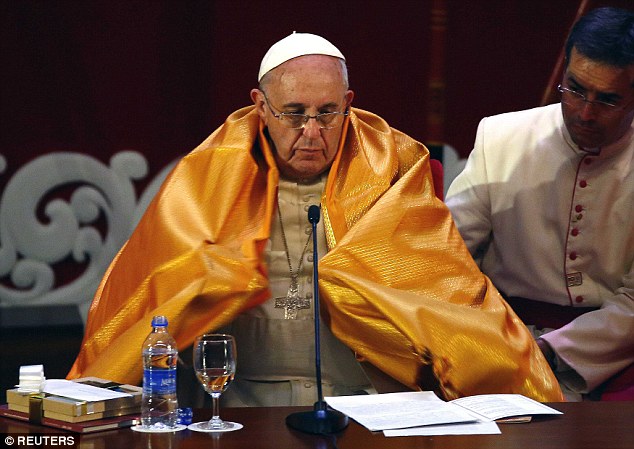
Bergoglio praying to false God of reincarnation:  Hindu priest Kurakkal Somasundaram presented a shawl to Anti pope Bergoglio, during an inter-religious meeting in Colombo, Sri Lanka.
Bergoglio praying to false God of reincarnation: Hindu priest Kurakkal Somasundaram presented a shawl to Anti pope Bergoglio, during an inter-religious meeting in Colombo, Sri Lanka. Jan/2015
Newchurch of Rot: honoring false gods again…
The Vatican is encouraging Buddhists and Christians to work together to end modern-day slavery, maintaining that the latter is an affront to human dignity and basic rights, a statement from the Pontifical Council for Inter-Religious Dialogue of the Roman Curia said.

The Council issued the statement, titled “Buddhists and Christians, together to counter modern slavery,” during the Buddhist holy month of Vesakh (April-May) when Buddhists commemorate Gautama Buddha’s birth, enlightenment and death.

The Vatican council emphasized the common respect that Buddhists and Christians have toward life.
“As Buddhists and Christians committed to respect for human life, we must cooperate together to end this social plague,” the Council said. “Pope Francis invites us to overcome indifference and ignorance by offering assistance to victims, in working for their psychological and educational rehabilitation, and in efforts to reintegrate them into society where they live or from which they come.”
Thou shalt not have strange gods before me. Exodus 20:3 - DRV
Thou shalt not have strange gods before me.
Exodus 20:3 – DRV
The Council recounted that Buddha himself opposed trade using human beings. Citing a section of the “Eightfold Path,” the Council said Gautama Buddha regarded trading in live beings such as slaves and prostitutes is one of the five occupations that should not be engaged in. According to Buddhist teachings, possessions should be obtained peacefully, with honesty, and through legal means, not in a way that causes harm or suffering and without coercion, violence or deceit, the Council noted.
The Council also blamed corruption as an impediment to seeing other people as one’s equal.
“Human hearts deformed by corruption and ignorance are, according to the Holy Father, the cause of these terrible evils against humanity. When hearts are corrupted, human beings no longer see others as ‘beings of equal dignity, as brothers or sisters sharing a common humanity, but rather as objects,'” the Council said.
In his message during this year’s World Day of Peace, Pope Francis said historically, slavery causes the “rejection of others, their mistreatment, violations of their dignity and fundamental rights, and institutionalizedinequality.”
The Pontiff noted that even though the international community has already adopted several measures to end slavery, there are still “millions of people today – children, women and men of all ages – deprived of freedom and forced to live in conditions akin to slavery.”
Heretic Bergoglio honors false Gods!!!!  Sacred Relics of the Buddha's Disciples...nothing sacred about other religions and their idol worship!!!!
Heretic Bergoglio honors false Gods!!!! Sacred Relics of the Buddha’s Disciples…nothing sacred about other religions and their idol worship!!!! January 14, 2015
The Pope cited the following instances of modern-day slavery: “Men, women and child laborers; migrants who undergo physical, emotional and sexual abuse while working in shameful working conditions; persons forced into prostitution, many of whom are minors, as well as male and female sex slaves; those kidnapped by terrorists and forced to be combatants, and those who are tortured, mutilated or killed.”


Newchurch of Mercy: Proclaiming jubilee, Francis envisions non-judging, non-condemning church!


God is Merciful, but He is also Just!
'I am just and merciful',  but sinners regard me only as merciful. – St. Bridget

Officially proclaiming the upcoming jubilee year of mercy, Pope Francis has powerfully called on the entire Catholic church to refashion itself as a place not of judgment or condemnation but of pardon and merciful love.

Officially proclaiming the upcoming jubilee year of mercy, Pope Francis has powerfully called on the entire Catholic church to refashion itself as a place not of judgment or condemnation but of pardon and merciful love.
Writing in an extensive document convoking the year, which will begin Dec. 8, the pontiff states that the church’s “very credibility is seen in how she shows merciful and compassionate love.”
“Perhaps we have long since forgotten how to show and live the way of mercy,” writes Francis in the document, released Saturday evening with the Latin title Misericordiae Vultus (“The Face of Mercy”).
“The temptation … to focus exclusively on justice made us forget that this is only the first, albeit necessary and indispensable step,” the pope continues.
“The time has come for the Church to take up the joyful call to mercy once more,” he states.
“It is time to return to the basics and to bear the weaknesses and struggles of our brothers and sisters,” writes the pontiff. “Mercy is the force that reawakens us to new life and instills in us the courage to look to the future with hope.”
Francis also notes that Dec. 8 will mark the 50th anniversary of the closing of the Second Vatican Council and says: “The Church feels a great need to keep this event alive.”
Francis’ document, released Saturday during a prayer service at St. Peter’s Basilica for the celebration of Divine Mercy Sunday, officially proclaims the extraordinary jubilee year the pontiff first announced last month.
The jubilee, which is to be called the Holy Year of Mercy, will begin on this year’s Catholic feast of the Immaculate Conception. It will close on Nov. 20, 2016, the day celebrated that year as the feast of Christ the King.
Explaining his reasons for calling the mercy jubilee with the some 9,500-word document Saturday, the pontiff firmly identifies mercy as the central function of the church and the key aspect of Jesus’ ministry and work.
Exhaustively citing from the teachings of previous popes and stories from the Old and New Testaments, Francis also says mercy is a key attribute of God’s actions towards human beings and that our own exercise of pardon will determine how we will eventually be judged.
In one section, the pope quotes from Peter’s question in Matthew’s Gospel about how many times it is necessary to forgive, where Jesus responds: “I do not say seven times, but seventy times seventy times.”
“This parable contains a profound teaching for all of us,” states Francis. “Jesus affirms that mercy is not only an action of the Father, it becomes a criterion for ascertaining who his true children are.”
“In short, we are called to show mercy because mercy has first been shown to us,” he continues. “Pardoning offences becomes the clearest expression of merciful love, and for us Christians it is an imperative from which we cannot excuse ourselves.”
Later in the document, the pope mentions that every holy year involves a process of pilgrimage for people — whether it be in coming to Rome to celebrate the year or in personal prayer.
Then, quoting from Luke’s Gospel, Francis outlines two steps everyone needs to make on their own pilgrimages.
“The Lord asks us above all not to judge and not to condemn,” states the pontiff. “If anyone wishes to avoid God’s judgment, he should not make himself the judge of his brother or sister.”
“Human beings, whenever they judge, look no farther than the surface, whereas the Father looks into the very depths of the soul,” writes Francis.
A jubilee year is a special year called by the church to receive blessing and pardon from God and remission of sins. The Catholic church has called jubilee years every 25 or 50 years since the year 1300 and has also called special jubilee years from time to time, known as extraordinary jubilee years.
The pope begins Saturday’s document by explaining the process of the holy year, saying that on Dec. 8 he will be opening the special holy door of St. Peter’s Basilica to mark the beginning of the jubilee.
Francis states that he hopes that with its opening, the door “will become a Door of Mercy through which anyone who enters will experience the love of God who consoles, pardons, and instills hope.”
To emphasize that the special year is just not for those able to come to Rome, the pontiff says he is going to ask every diocese to identify a similar “Door of Mercy” at a cathedral or other special church to be opened during the year.
“Every Particular Church, therefore, will be directly involved in living out this Holy Year as an extraordinary moment of grace and spiritual renewal,” writes the pope.
Archbishop Marcel Lefebvre  we are not of this religion

Vatican II Rotten Fruits…  Church of the past was Judgmental and Condemning… 

Francis notes that the holy year will begin on the 50th anniversary of the closing of the Second Vatican Council.

“With the Council, the Church entered a new phase of her history,” writes Francis. “The Council Fathers strongly perceived, as a true breath of the Holy Spirit, a need to talk about God to men and women of their time in a more accessible way.

“The walls which too long had made the Church a kind of fortress were torn down and the time had come to proclaim the Gospel in a new way,” he continues. “It was a new phase of the same evangelization that had existed from the beginning.”
Among other special initiatives for the holy year, Francis also announces Saturday that during the 2016 season of Lent he will be asking some priests to serve as special “Missionaries of Mercy.”
** The pontiff says he will ask those priests to go around the world to hear confessions and that he will grant them “the authority to pardon even those sins reserved to the Holy See!” (??)
With that authority, the pope states, the priests will be “living signs of the Father’s readiness to welcome those in search of his pardon.”
“I ask my brother Bishops to invite and welcome these Missionaries so that they can be, above all, persuasive preachers of mercy,” writes Francis.
The pontiff also says he is giving the holy year a motto taken from Luke’s Gospel: “Merciful like the Father.”
‘God’s justice is his mercy’ (??!!)
Francis spends about two pages in the document addressing the relationship between mercy and justice, which he says, “are not two contradictory realities, but two dimensions of a single reality that unfolds progressively until it culminates in the fullness of love.”
Mentioning the Bible’s frequent use of the image of God as a judge, Francis says that in many passages, “justice is understood as the full observance of the Law and the behavior of every good Israelite in conformity with God’s commandments.”
But he continues: “Such a vision … has not infrequently led to legalism by distorting the original meaning of justice and obscuring its profound value.”
“To overcome this legalistic perspective, we need to recall that in Sacred Scripture, justice is conceived essentially as the faithful abandonment of oneself to God’s will,” writes the pope.
Quoting Jesus’ response to the Pharisees in Matthew’s Gospel — “Go and learn the meaning of ‘I desire mercy not sacrifice.’” — Francis says, “Jesus is bent on revealing the great gift of mercy that searches out sinners and offers them pardon and salvation.”
“One can see why, on the basis of such a liberating vision of mercy as a source of new life, Jesus was rejected by the Pharisees and the other teachers of the law,” he continues. “In an attempt to remain faithful to the law, they merely placed burdens on the shoulders of others and undermined the Father’s mercy.”
Meditating then on Paul’s letter to the Philippians, Francis states that, “Paul’s understanding of justice changes radically. He now places faith first, not justice.”
“Salvation comes not through the observance of the law, but through faith in Jesus Christ, who in his death and resurrection brings salvation together with a mercy that justifies,” writes the pope.
“God’s justice now becomes the liberating force for those oppressed by slavery to sin and its consequences,” he continues. “God’s justice is his mercy.”
Continuing on that theme by exploring the words of the prophet Hosea, Francis states: “If God limited himself to only justice, he would cease to be God, and would instead be like human beings who ask merely that the law be respected.”
“But mere justice is not enough,” he writes. “Experience shows that an appeal to justice alone will result in its destruction. This is why God goes beyond justice with his mercy and forgiveness.”
Jesus: ‘Nothing but love’
Earlier in the document, Francis focuses on Jesus’ ministry during his earthly life as a sign of the centrality of mercy in the Christian faith.
Citing St. Thomas Aquinas, Francis says that “God’s mercy, rather than a sign of weakness, is the mark of his omnipotence.”
“The mercy of God is not an abstract idea, but a concrete reality through which he reveals his love as that of a father or a mother, moved to the very depths out of love for their child,” states the pope.
“It is hardly an exaggeration to say that this is a ‘visceral’ love,” he says. “It gushes forth from the depths naturally, full of tenderness and compassion, indulgence and mercy.”
Francis mentions how the Gospel of Matthew’s account of Jesus’ passion states that before his death Jesus sung a hymn that may have been Psalm 136: “For his mercy endures forever.”
“While he was instituting the Eucharist as an everlasting memorial of himself and his paschal sacrifice, he symbolically placed this supreme act of revelation in the light of his mercy,” writes Francis.
“Within the very same context of mercy, Jesus entered upon his passion and death, conscious of the great mystery of love that he would consummate on the cross,” he continues.
“Knowing that Jesus himself prayed this psalm makes it even more important for us as Christians, challenging us to take up the refrain in our daily lives by praying these words of praise: ‘for his mercy endures forever.'”
Jesus’ person, says Francis, “is nothing but love, a love given gratuitously.”
“The relationships he forms with the people who approach him manifest something entirely unique and unrepeatable,” states the pope. “The signs he works, especially in the face of sinners, the poor, the marginalized, the sick, and the suffering, are all meant to teach mercy. Everything in him speaks of mercy.”
“Nothing in him is devoid of compassion,” he says.
Jesus, Francis says, also reveals God’s nature “as that of a Father who never gives up until he has forgiven the wrong and overcome rejection with compassion and mercy.”
Mentioning the fifth beatitude — “Blessed are the merciful, for they shall obtain mercy” — the pope states that is the beatitude “to which we should particularly aspire in this Holy Year.”
Speaking of how God acts with humans, the pope says, “mercy is a key word that indicates God’s action towards us.”
“The mercy of God is his loving concern for each one of us,” writes Francis. “He feels responsible; that is, he desires our wellbeing and he wants to see us happy, full of joy, and peaceful.”
“This is the path which the merciful love of Christians must also travel,” he continues. “As the Father loves, so do his children. Just as he is merciful, so we are called to be merciful to each other.”
Applying that attribute to the level of the church, Francis states: “Mercy is the very foundation of the Church’s life.”
“All of her pastoral activity should be caught up in the tenderness she makes present to believers; nothing in her preaching and in her witness to the world can be lacking in mercy,” writes the pope.
‘Opening our hearts’
The pontiff also asks that people live the Holy Year by “opening our hearts to those living on the outermost fringes of society: fringes modern society itself creates.”
“How many uncertain and painful situations there are in the world today!” exhorts Francis. “How many are the wounds borne by the flesh of those who have no voice because their cry is muffled and drowned out by the indifference of the rich!”
“Let us not fall into humiliating indifference or a monotonous routine that prevents us from discovering what is new!” he continues. “Let us ward off destructive cynicism!
“Let us open our eyes and see the misery of the world, the wounds of our brothers and sisters who are denied their dignity, and let us recognize that we are compelled to heed their cry for help!” he exhorts, again.
Francis also says that is his “burning desire” that during the jubilee year people reflect on the corporal and spiritual works of mercy, Christian actions and practices attributed to Jesus’ directive in Matthew’s Gospel for how his followers should act.
“We cannot escape the Lord’s words to us, and they will serve as the criteria upon which we will be judged: whether we have fed the hungry and given drink to the thirsty, welcomed the stranger and clothed the naked, or spent time with the sick and those in prison,” states Francis.
Inter-religious dimension
Francis also refers the practice of the mercy jubilee to Judaism and Islam, saying: “There is an aspect of mercy that goes beyond the confines of the Church.” (??)
The pope notes both that “the pages of the Old Testament are steeped in mercy” and that Muslims often refer to the creator as “Merciful and Kind.”
“I trust that this Jubilee year celebrating the mercy of God will foster an encounter with these religions and with other noble religious traditions,” states Francis.
“May it open us to even more fervent dialogue so that we might know and understand one another better; may it eliminate every form of closed-mindedness and disrespect, and drive out every form of violence and discrimination,” he asks.
Francis’ document proclaiming the holy year, officially known as a bull of induction, was released by the Vatican in six languages.
During the prayer service Saturday, Francis symbolically gave the bull to the four cardinal archpriests of the Papal Basilicas. He also gave a copy to Cardinal Marc Ouellet, the prefect of the Congregation for Bishops, for distribution to bishops around the world.
The document is signed by Francis with the title “Bishop of Rome, Servant of the Servants of God,” and has an invocation “to all who read this letter grace, mercy, and peace.”

 BULL OF INDICTION


Bus tickets to Pope Francis Mass sell out in one hour!


           ‘Rockstar’ Bergoglio...
On Tuesday, bus tickets to the Papal Mass in September in Philadelphia sold out in one hour.

The Diocese of Harrisburg, which began to sell the tickets Tuesday morning, suspended the sale one hour later as demands for the tickets reached - perhaps even surpassed - capacity.

The diocese, which has chartered 30 buses, was offering 1,700 sets on the buses, each going for $30.

"We knew there would be a lot of interest in this," said diocese spokesman Joe Aponick. "I think we thought the tickets would go within a day but to have them go within an hour was a little bit of a surprise."

An estimated 2 million people are expected in Philadelphia in September when Francis caps his first trip to the U.S. with a two-day stop there. 

Francis is scheduled to make stops in Washington, D.C. and New York. He will be in Philadelphia on Sept. 26-27 and will celebrate Mass that Sunday on the Benjamin Franklin Parkway outside the Philadelphia Art Museum.

Francis has already had an impact in the housing rental market. Rental properties in the Philadelphia region are, in some cases, going for thousands of dollars. Organizers expect hotel rooms to sell out, as well.


Aponick said the diocese, which is tallying sales by the web, phone and e-mail, would assess the demand for tickets but it was unlikely it would add any more buses to its fleet of 30 already chartered.

"I  think it's going to be difficult to add any more buses," he said. He did not rule it out, though.

The $30-per-seat tickets provide only round-trip transportation to the event, and does not include meals.


BERGOGLIO TO USE OUR LORD'S GOOD FRIDAY PASSION TO FURTHER HIS AGENDA...


He was offered because it was his own will, and he opened not his mouth: he shall be led as a sheep to the slaughter, and shall be dumb as a lamb before his shearer, and he shall not open his mouth.  Isaiah 53: 7 - DRV

Unbelievable! Bergoglio uses our Lord's crucifixion to blast death penalty! Is this pope even A Christian... Compares our Lord's passion, suffering and death to slime of the earth, criminals and the 'unjust' death penalty!   

A series of reflections to be used by Pope Francis in Rome on Good Friday make connections between the crucifixion of Jesus and the modern-day use of the death penalty.


The reflections, to be used by the pope at an annual public service in and near Rome’s historic Colosseum, pointedly ask: “When will the death penalty, still practiced in many states, be abolished?”

That question is part of a service known as the “Way of the Cross,” a type of liturgical service frequently celebrated by Christians on Good Friday. The service follows Jesus through different stations of his torture and eventual crucifixion, with reflections on his suffering at each point.

Good Friday, the day Christians mark the death of Jesus, is marked this year by the Catholic church and most western churches on April 3.

Francis will mark the occasion by presiding over a “Way of the Cross” service Friday night that begins in the Colosseum and continues onto Rome’s Palatine Hill. At each station of Jesus’ suffering, the pontiff and those attending the outdoor celebration will reflect using a text prepared for the event by retired Italian Bishop Renato Corti.

At the station that marks Jesus being nailed to the cross, Francis and the pilgrims will use a reflection that questions modern-day uses of both the death penalty and torture.


“We gaze at you, Jesus, as you are nailed to the cross,” states the reflection. “And our conscience is troubled.”


“We anxiously ask: When will the death penalty, still practiced in many states, be abolished?” it continues. “When will every form of torture and the violent killing of innocent persons come to an end? Your Gospel is the surest defense of the human person, of every human being.”

While Catholic teaching holds that the death penalty can be used in a situation where the public authority can find no other way to contain a dangerous person, the last several popes have said that such situations likely no longer exist.

Francis has been even more publicly opposed to the practice, saying March 20 
"today the death penalty is inadmissible, no matter how serious the crime committed.”

Corti, who wrote the reflections for the Good Friday service at Francis’ request, was the bishop of the northern Italian town of Novara from 1990 until his retirement in 2011. He had previously served as an auxiliary bishop in Milan under the late Cardinal Carlo Martini.

The retired bishop’s reflections for the papal Good Friday service have a theme of God’s protective love for humanity. Throughout the service, the bishop presents some possible feelings and thoughts of Jesus during his suffering and then offers a “resonance” reflection for those present at the ceremony.
In another part of the service, Corti also connects Jesus’ suffering with persecution of Christians around the world. At the station that marks when Jesus was forced to carry the cross of his own crucifixion, the bishop says such persecution “has happened repeatedly throughout history.”

“In our day too, men and women are imprisoned, condemned and even slaughtered for the simple reason that they are believers or engaged in promoting justice and peace,” states the reflection. “They are not ashamed of your cross. For us they are wonderful examples to imitate.”

Bergoglio hides Christ from the Jews
Related - Flash back to 2014 -  MEDITATIONS on economic crisis, unemployment, ISLAMIC IMMIGRANTS, TOXIC WASTE and OVERCROWDING in PRISONS!


Pope Francis will become the first pontiff to address the US Congress after accepting an invitation to visit the White House


Pope Francis will become the first pontiff to address the US Congress after accepting an invitation to visit the White House

The announcement comes after US President Barack Obama’s invitation to visit the White House September 23

The 78-year-old confirmed late last year that he would visit the US to take part in a Catholic Church congress in Philadelphia

During the trip, he will also address the United Nations in New York and become the first pontiff to address the US Congress
Pope Francis will become the first pontiff to address the US Congress after accepting an invitation to visit the White House.

US President Barack Obama will host the Pope on September 23, after extending an invitation during talks at the Vatican last year.


The White House said the president and the pope will continue a dialogue about poverty, the environment, immigration and promoting religious freedom.

Papal first: Pope Francis has announced his intention to address the US Congress during a stateside visit in September--which will make him the first pope to ever do so
‘The president looks forward to continuing this conversation with the Holy Father during his first visit to the United States as pope,’ a statement said.
The 78-year-old leader of the world’s Roman Catholics confirmed late last year that he would visit the United States to take part in a Catholic Church congress in Philadelphia.
During the trip, he will also address the United Nations in New York and become the first pontiff to address the US Congress.
Obama and Francis met for the first time at the Vatican in March last year in talks clouded by disagreements over provisions for contraception included in the US leader’s landmark health care reforms.
Dialogue: Pope Francis will continue a dialogue about poverty, the environment, immigration and promoting religious freedom
Obama has regularly spoken of his admiration for Francis, repeatedly praising the pontiff for his compassion and modesty.
‘As a champion of the poor and the most vulnerable among us, he carries forth the message of love and compassion that has inspired the world for more than two thousand years – that in each other we see the face of God,’ Obama said last year.
Francis is also widely credited with helping to kickstart the secret diplomacy between Cuba and the United States which culminated with the two Cold War rivals declaring a historic rapprochement last year.
According to a Vatican statement, Francis wrote letters to US and Cuban leaders and ‘invited them to resolve humanitarian questions of common interest, including the situation of certain prisoners, in order to initiate a new phase in relations between the two parties.’
Obama has regularly spoken of his admiration for Francis, repeatedly praising the pontiff for his compassion and modesty. The U.S. president visited Francis at the Vatican in March

Obama has regularly spoken of his admiration for Francis, repeatedly praising the pontiff for his compassion and modesty. The U.S. president visited Francis at the Vatican in March


Daily Mail


Marxist Pope Bergoglio traveling the globe to promote his Socialist  Agenda...

5 Things President Obama Wants To Discuss With Pope Francis When The Pontiff Comes To Town
President Barack Obama is slated to meet with Pope Francis in Washington, D.C., on Sept. 23, and Obama already has a list of topics he hopes to discuss. In a press release Thursday, the White House laid out some of the president's ideal subjects for the talk, and said that Obama "looks forward to continuing" conversations he and Pope Francis began during their initial meeting at the Vatican in March 2014.

The topics on Obama's agenda are ones that both leaders have made top priorities in their careers thus far. Here's what he hopes to chat about with the pope:

Poor And Marginalized Populations

slum pope francis

Pope Francis sits with children from the Anak-Tnk Foundation, a group that works to help homeless children and those living in the slums, in Manila's Intramuros district on Jan. 16, 2015.
Pope Francis in his 2013 Evangelii Gaudium:
"Each individual Christian and every community is called to be an instrument of God for the liberation and promotion of the poor, and for enabling them to be fully a part of society. This demands that we be docile and attentive to the cry of the poor and to come to their aid."
Obama in a 2007 speech to the Town Hall Education Arts Recreation Campus in Washington, D.C.:
“If poverty is a disease that infects an entire community in the form of unemployment and violence; failing schools and broken homes, then we can’t just treat those symptoms in isolation. We have to heal that entire community. And we have to focus on what actually works."
Environmental Stewardship
obama environment
Obama and Deputy Energy Secretary Liz Sherwood-Randall talk about solar panels on the roof of the Department of Energy on March 19, 2015.
Pope Francis in his Feb. 9, 2015, homily:
"A Christian who does not protect creation, who does not let it grow, is a Christian who does not care about the work of God; that work that was born from the love of God for us. And this is the first response to the first creation: Protect creation, make it grow."
Obama in his 2015 State of the Union address:
"No challenge  poses a greater threat to future generations than climate change. ... The best scientists in the world are all telling us that our activities are changing the climate, and if we do not act forcefully, we'll continue to see rising oceans, longer, hotter heat waves, dangerous droughts and floods and massive disruptions that can trigger greater migration, conflict and hunger around the globe."
Religious Freedom
pope francis religious freedom
Pope Francis exchanges gifts with members of a delegation accompanying the Tunisian president during a private audience on Sept. 11, 2014, in Vatican City. Attendees discussed religious liberty and the rejection of all forms of violence and extremism.
Obama at the 2015 National Prayer Breakfast:
"The concern for the protection of [religious freedom] rights calls for each of us to exercise civility and restraint and judgment, and if in fact we defend the legal right of a person to insult another's religion, we're equally obligated to use our free speech to condemn such insults and stand shoulder-to-shoulder with religious communities, particularly religious minorities who are targets of such attacks."
Pope Francis at the 2014 "International Religious Liberty and the Global Clash of Values" conference in Rome:
"Religious freedom is not just a matter of thought or private devotion. It is the freedom to live -- both privately and publicly -- according to the ethical principles that are a consequence of the truth found."
Economic Opportunity
obama economy
Obama tours the Manufacturing Advocacy & Growth Network on March 18, 2015.
Obama in a Jan. 8, 2014, statement about the war on poverty:
"We must redouble our efforts to make sure our economy works for every working American. It means helping our businesses create new jobs with stronger wages and benefits, expanding access to education and health care, rebuilding those communities on the outskirts of hope and constructing new ladders of opportunity for our people to climb."
Pope Francis in his 2013 Evangelii Gaudium:
"Just as the commandment 'Thou shalt not kill' sets a clear limit in order to safeguard the value of human life, today we also have to say 'thou shalt not' to an economy of exclusion and inequality. Such an economy kills."
Immigration Reform
pope francis immigration
Pope Francis greets migrants during his visit to the island of Lampedusa, Italy, on July 8, 2013. The island is a key destination for tens of thousands of would-be immigrants from Africa.
Obama in a speech on November 21, 2014:
"We didn’t raise the Statue of Liberty with her back to the world, we did it with her light shining as a beacon to the world. And whether we were Irish or Italians or Germans crossing the Atlantic, or Japanese or Chinese crossing the Pacific; whether we crossed the Rio Grande or flew here from all over the world -- generations of immigrants have made this country into what it is. It’s what makes us special."
Pope Francis in his 2013 remarks on the tragedy at Lampedusa:
"These our brothers and sisters seek to leave difficult situations in order to find a little serenity and peace, they seek a better place for themselves and for their families -- but they found death. How many times to those who seek this not find understanding, do not find welcome, do not find solidarity! And their voices rise up even to God!"
Source