|
Disputation of Holy
Sacrament by Raphael, 1509-1510
|
May 26
FEAST OF CORPUS CHRISTI
By: Rev. Fr. Leonard Goffine
Why is this day called Corpus Christi?
Because on this Thursday the Catholic Church celebrates the institution of the most Blessed Sacrament of the Altar. The Latin term Corpus Christi signifies in English, Body of Christ.
Who instituted this festival?
Pope Urban IV, who, in the decree concerning it, gives the following explanation of the institution and grandeur of this festival: "Although we daily, in the holy Sacrifice of the Mass; renew the memory of this holy Sacrament, we believe that we must, besides, solemnly commemorate it every year, to put the unbelievers to shame; and because vie have been informed that God has revealed to some pious persons that this festival should be celebrated in the whole Church, we direct that on the first Thursday after the octave of Pentecost the faithful shall assemble in church, join with the priests in singing the word of God." Hence this festival was instituted on account of the greatness of the divine mystery; the unbelief of those who denied the truth of this mystery; and the revelation made to some pious persons. This revelation was made to a nun at Liege, named Juliana, and to her devout friends Eve and Isabella. Juliana, when praying, had frequently a vision in which she saw the bright moon, with one part of it somewhat dark; at her request she received instructions from God that one of the grandest festivals was yet to be instituted the festival of the most Blessed Sacrament of the Altar. In 1246, she related this vision to Robert, Bishop of Liege, who after having investigated the matter with the aid . of several men of learning and devotion, among whom was Jacob Pantaleon, Archdeacon of Liege, afterwards Pope Urban IV. made arrangements to introduce this festival m his diocese, but death prevented his intention being put into effect. After the bishop's death the Cardinal Legate Hugh undertook to carry out his directions, and celebrated the festival for the first time in the year 1247, in the Church of St. Martin at Liege. Several bishops followed this example, and the festival was observed in many dioceses, before Pope Urban IV. in 1264 finally ordered its celebration by the whole Church. This order was confirmed by Clement V, at the Council of Vienna in 1311, and the Thursday after the octave of Pentecost appointed for its celebration. In 1317, Pope John XXII. instituted the solemn procession.
Why are there such grand processions on this day?
For a public profession of our holy faith that Christ is really, truly and substantially present in this Blessed Sacrament; for a public reparation of all the injuries, irreverence, and offences, which have been and are committed by impious men against Christ in this Blessed Sacrament; for the solemn veneration and adoration due to the Son of God in this Sacrament; in thanksgiving for its institution; and for all the graces and advantages received therefrom; and finally, to draw down the divine blessing upon the people and the country.
Had this procession a prototype in the Old Law?
The procession in which was carried the Ark of the Covenant containing the manna, was a figure of this procession.
The Church sings at the Introit the words of David:
INTROIT
He fed them with the fat of wheat, alleluia: and filled them with honey out of the rock. Alleluia, alleluia alleluia. Rejoice to God our helper; sing aloud to the God of Jacob. (Ps. LXXX.) Glory...
COLLECT
O God, who under a wonderful sacrament hast left us a memorial of Thy Passion; grant us, we beseech Thee, so to venerate the sacred mysteries of Thy body and blood, that we may ever feel within us the fruit of thy redemption. Who livest...
EPISTLE
I Cor. XI. 23-29
Brethren, I have received of the Lord, that which also I delivered to you, that the Lord Jesus, the same night in which he was betrayed, took bread, and giving thanks, broke, and said: Take ye, and eat; this is my body which shall be delivered for you: this do for the commemoration of me. In like manner also the chalice, after he had supped, saying: This Chalice is the New Testament in my blood: this do' ye; as often as you shall drink., for the commemoration of me. For as often as you shall eat this bread, and drink this chalice, you shall show the death of the Lord until he come. Therefore, whosoever shall eat this bread, or drink of the chalice of the Lord unworthily, shall be guilty of the body and of the blood of the Lord. But let a man prove himself: and so let him eat of that bread, and drink of the chalice. For he that eateth and drinketh unworthily, eateth and drinketh judgment to himself, not discerning the body of the Lord.
GOSPEL (John VI. 56?59.) At that time, Jesus laid to the multitude of the Jews: My flesh is meat indeed arid my blood is drink indeed. He that eateth my flesh, and drinketh my blood, abideth in me, and I in him. As the living Father hath sent me, and I live by the Father: so he that eateth me, the same also shall live by me. This is the bread that came down from heaven. Not as your fathers did eat manna and are dead. He that eateth this bread shall live forever.
[The explanation of the epistle and gospel is contained in the following instruction.]
The Jews, liberated by the powerful hand of God from Egyptian captivity, went on dry ground through the midst of the Red Sea, whose waters became the grave of their pursuer, King Pharao, and, his whole army. Having arrived in the desert called Sin they began to murmur against Moses and Aaron, their leaders; on account of the want of bread, and demanded to be led back to Egypt where there was plenty. The Lord God took pity on His people. In the evening He sent into their, camp great flocks of quails, which the Jews caught and ate, and on the morning of the next day the ground was covered with white dew, and in the desert something fine, as if pounded in a mortar, looking like frost on the earth, which as soon as the Jews beheld, they exclaimed in surprise: "Man hu?" "What is that?" But Moses said to them: "This is bread which the Lord has given you." And they at once began to collect the food which was white, small as Coriander seed, and tasted like wheat?bread and honey, and was henceforth called man or manna. God gave them this manna every morning, for forty years, Sabbaths excepted, and the Jews lived upon it in the desert, until they came to the Promised Land. This manna is a figure of the Blessed Sacrament of the Altar which contains all sweetness, and nourishes the soul of him who receives it with proper preparation, so that whoever eats it worthily, dies not, though his body sleeps in the grave, for Christ will raise him to eternal life.
INSTRUCTION ON THE MOST HOLY SACRAMENT OF THE ALTAR
What is the Sacrament of the Altar?
It is that Sacrament in which under the appearance of bread and wine the Body and Blood of our Lord Jesus Christ are really, truly and substantially present.
When and to what manner did Christ promise this Sacrament?
About one year before its institution He promised it in the synagogue at Capharnaum, according to St. John the Evangelist: (VI, 24-65.) When Jesus, near the Tiberian Sea, had fed five thousand men in a miraculous manner with a few small loaves, these men would not leave Him, because they marvelled at the miracle, were anxious for this bread, and desired to make Him their king. But Jesus fled to a high mountain, and in the night went with His disciples to Capharnaum which was a town on the opposite side of the sea; but a multitude of Jews followed Him, and He made use of the occasion to speak of the mysterious, bread which He would one day give them and all men. He first exhorted them not to go so eagerly after the perishable. bread of the body, but to seek the bread of the soul which lasts forever, and which the Heavenly Father would give them, through Him, in abundance. This imperishable bread is the divine word, His holy doctrine, especially the doctrine that He had come from heaven to guide us to eternal life. (Vers. 25-38.) The Jews murmured because He said that He had come from heaven, but the Saviour quieted them by showing that no one could believe without a special grace from His Heavenly Father (V. 43, 44.) that He was the Messiah, and had come from heaven. After this introduction setting forth that the duty of faith in Him and in His divine doctrine was a spiritual nourishment, Christ very clearly unfolded the mystery of another bread for the soul which was to be given only at some future time, and this the Saviour did not ascribe to the Heavenly Father, as He did the bread of the divine word, but to Himself by plainly telling what this bread was: I am the living bread which came down from heaven. If any man eat of this bread, he shall live forever, and the bread that I will give, is my flesh for the life of the world. (V. 51, 52.)
But the Jews would not believe these words, so clearly expressed, for they thought their fulfillment impossible, and said: How can this man give us his flesh to eat?
(V. 53.) But Jesus recalled not His words, answered not the Jews' objections, but confirmed that which He had said, declaring with marked emphasis: Amen, amen, I say unto you, except you eat the flesh of the Son of Man, and drink his blood, you shall not have life in you., (V. 54.) He that eateth my flesh and drinketh my blood, hath everlasting life, and I will raise him up in the last day. For my flesh is meat indeed: and my blood is drink indeed; he that eateth my flesh and drinketh my blood, abideth in me, and I in him. As the living Father bath sent me; and I live ,by the Father; so he that eateth me, the same also shall live by me. This is the bread that came down from heaven. Not as your fathers did eat manna, and are dead. He that eateth this bread; shall live forever: (V. 55-59.) Jesus, therefore, said distinctly and plainly, that at a future time He would give His own Body and Blood as the true nourishment of the soul; besides, the Jews and the disciples alike received these words in their true, literal sense, and knew that Jesus did not here mention His Body and Blood in figurative sense, but meant to give them His own real Flesh and Blood for food; and it was because they believed it impossible for Jesus to do this, and because they supposed He would give them His dead flesh in a coarse, sensual manner, that the Jews murmured, and even several of His disciples said: This saying is hard, and who can hear it? But Jesus persisted in His words: My flesh is meat indeed, &c., and calls the attention of His disciples to another miracle: to His future ascension, which would be still more incredible, but would come to pass; and by the words: It is the spirit which quickeneth, the flesh profiteth nothing, the words that I have spoken to you, are spirit and life, (V. 64) He showed them that this mystery could be believed only by the light and grace of the Holy Spirit, and the partaking of His Bodes and Blood would not be in a coarse, sensual manner, but in a mysterious way. Notwithstanding this, many of His disciples still found the saying hard, and left Him, and went no longer with Him. (V. 67.) They found the saying hard, because, as our Saviour expressly said, they were lacking in faith. He let them go, and said to His apostles: Will you also go away? thereby showing that those who left Him, understood Him clearly enough, and that His words did contain something hard for the mind to believe. The apostles did not leave Him, they were too well assured of His divinity, and that to Him all was possible, as St. Peter clearly expresses: Lord, to whom shall we go? Thou hast the words of eternal life. And we have believed and have known that thou art Christ, the Son of God.
From the account given by St. John, it is plainly seen that Christ really promised to give us for our food His most precious Body and Blood, really and substantially, in a Wonderful, mysterious manner, and that He did not speak figuratively of faith in Him, as those assert who contemn this most holy Sacrament. If Jesus had so meant it, He would have explained it thus to the Jews and to His disciples who took His words literally, and therefore could not comprehend, how Jesus could give His Flesh and Blood to them for their food. But Jesus persisted in His words, that His Flesh was truly food, and His Blood really drink. He even made it the strictest duty for man to eat His Flesh and drink His Blood; (V. 54) He shows the benefits arising from this nourishment of the soul, (V. 55) and the reason why this food is so necessary and useful. (V. 56.) When His disciples left Him, because it was a hard saying, He allowed them to go, for they would not believe His words, and could not believe them on account of their carnal manner of thinking. This holy mystery must be believed, and cannot be comprehended. Jesus has then promised, as the Catholic Church has always maintained and taught, that His Body and Blood. would be present under the appearance of bread and wine in the Blessed Sacrament, a true nourishment for the soul, and that which He promised, He has really given.
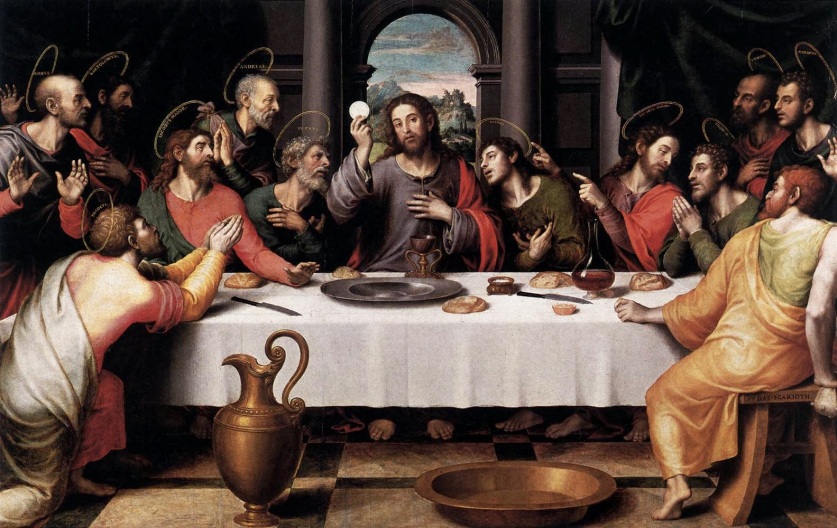
When and in what manner did Christ institute the most holy Sacrament of the Altar?
At the Last Supper, on the day before His passion, after He had eaten with His apostles the paschal lamb, which was a prototype of this mystery. Three Evangelists, Matthew, (XXVI: 26?29.) Mark, (XIV. 22-25.) and Luke (XXII. 19-20.) relate in few, but plain words, that on this evening Jesus took into His hand bread and the chalice, blessed and gave both to His disciples, saying: This is my body, that will be given for you; this is my blood, which will be shed for you and for many. Here took place in a miraculous manner, by the all?powerful word of Christ, the mysterious transformation; here Jesus gave Himself to His apostles for food, and instituted that most holy meal of love which the Church says contains all sweetness. That which three Evangelists. plainly relate, St. Paul confirms in his first epistle to the Corinthians, (XI. 23-29. ,See this day's epistle) in which to his account of the institution of the Blessed Sacrament he adds: Whosoever shall eat this bread, or drink the chalice of the Lord unworthily, (that is, in a state of sin) shall be guilty of the body and of the blood of the Lord . . . .eateth and drinketh judgment to himself. (V. 27-29.)
From these words and those of the three holy Evangelists already mentioned, it is clear that Jesus really fulfilled His promise, really instituted the most holy Sacrament, and gave His most sacred Body and Blood to the apostles for their food. None of the Evangelists, nor St. Paul, informs us that Christ said: this will become my body, or, this signifies my body. All agree that our Saviour said this is my body, this is my blood, and they therefore decidedly mean us to understand that Christ's body and blood are really, truly, and substantially present under the appearance of bread and wine, as soon as the mysterious change has taken place. And this is confirmed by the words: that is given for you; which shall be shed for you and for many; because Christ gave neither bread nor wine, nor a figure of His Body and Blood, for our redemption, but His real Body, and His real Blood, and St. Paul could not assert that we could eat the Body and Blood of the Lord unworthily, if under the appearance of bread and wine were present not the real Body and Blood of Christ, but only a figure of them, or if they were only bread and wine. This is also proved by the universal faith of the Catholic Church, which in accordance with Scripture and the oldest, uninterrupted Apostolic traditions has always believed and taught, that under the appearance of bread and wine the real Body and Blood of Christ are present, as the Ecumenical Council of Trent expressly declares: (Sess. XIII. C. I. Can. I. de sacros. Euchdr.) "All our ancestors who were of the Church of Christ, and have spoken of this most Blessed Sacrament, have in the plainest manner professed that our Redeemer instituted this wonderful Sacrament at the Last Supper, when, having blessed the bread and wine, He assured the apostles in the plainest and most exact words, that He was giving them His Body and Blood itself; and if any one denies that the holy Eucharist truly, really, and substantially contains the Body and Blood, the Soul and Divinity of, our Lord Jesus Christ, therefore the whole Christ, and asserts that it is only a sign or figure without virtue, let him be anathema."
Did Christ institute this Sacrament for all time?
Yes; for when He had promised that the bread which He would give, was His flesh for the life of the world, (john. vi. ga.) and had said expressly that whosoever did not eat His Flesh and drink His Blood would not have life in Him, He, at the Last Supper, by the words: Do this for a commemoration of me, (Luke XXII. 19.) gave to the apostles and their successors, the priests, the power in His name to change bread and wine into His Body and Blood, also to receive It and administer It as a food of the soul, which power the apostles and their successors, the priests, have always exercised, (I Coy. X. 16.) and will exercise to the end of the world.
How long after the change does Christ remain present under the appearance of bread and wine?
As long as the appearances remain; this was always the faith of the Church; therefore in the primitive ages when the persecutions were raging, after the sacrifice the sacred body of our Lord was taken home by the Christians to save the mystery from the pagans; at home they preserved It, and received It from their own hands, as affirmed by the holy Fathers of the Church Justin, Cyprian, Basil, and others. But when persecution had ceased, and the Church was permitted to profess the faith openly, and without hinderance, the Blessed Sacrament was preserved in the churches, enclosed in precious vessels, (ciborium, monstrance, or ostensorium) made for the purpose. In later times it was also exposed, on solemn occasions, for public adoration.
Do we Catholics adore bread when we pay adoration to the Blessed Sacrament?
No; we do not adore bread, for no bread is there, but the most sacred Body and Blood of Christ, and wherever Christ is adoration is due Him by man and angels. St. Augustine says: "No one partakes of this Body until he has first adored, and we not only do not sin when we adore It, but would sin if we did not adore It." The Council of Trent excommunicates those who assert that it is not allowable to adore Christ, the only?begotten Son of God, in the Blessed Sacrament. How unjust are those unbelievers who sneer at this adoration, when it has never entered into the mind of any Catholic to adore the external appearances of this Sacrament, but the Saviour hidden under the appearances; and how grievously do those indifferent Catholics sin who show Christ so little veneration in this Sacrament, and seldom adore Him if at all!
Which are the external signs of this Sacrament?
The form and appearance, or that which appears to our senses, as the figure, the color, and the taste, but the substance of the bread and wine is by consecration changed into the real Body and Blood of Christ, and only the appearance of bread and wine remains, and is observable to the senses.
Where and by whom is this consecration effected?
This consecration is effected on the altar during the holy Sacrifice of the Mass (therefore the name Sacrament of the Altar), when the priest in the name and by the power of Christ pronounces over the bread and wine the words which Christ Himself pronounced when He instituted this holy Sacrament. St. Ambrose writes: "At the moment that the Sacrament is to be accomplished, the priest no longer uses his own words, but Christ's words therefore. Christ's words complete the Sacrament."
Is Christ present under each form?
Christ is really and truly present under both forms, in Divinity and Humanity, Body and Soul, Flesh and Blood. That Jesus is thus present is clear from the words of St. Paul: Knowing that Christ rising again from the dead, dieth now no more. (Rom. VI. 9.) Because Christ dies no more, it naturally follows that He is wholly and entirely present under each' form. Hence the council of Trent says: "Whoever denies that in the venerable Sacrament, of the Eucharist the whole Christ is present in each of the forms and in each part of each form, where a separation has taken place, let him be anathema."
Then no matter how many receive this Sacrament, does each receive Christ?
Yes, for each of the apostles received Christ entirely, and if God by His omnipotence can cause each individual to rejoice at the same instant in the sun's light, and enjoy its entireness, and if He can make one and the same voice resound in the ears of all the listeners, is He not able to give the body of Christ, whole and entire, to as many as wish to receive It?
Is it necessary that this Sacrament should be received in both forms?
No, for as it has already been said, Christ is wholly present, Flesh and Blood, Humanity and Divinity, Body and Soul, in each of the forms. Christ promises eternal life to the recipient also of one form when He says,: I f any man eat of this bread, he shall live for ever, and the bread that I will give, is my flesh for the life of the world. (John. VI. 52.) The first Christians, in times of persecution, received this Sacrament only in the form of bread in their houses. Though in earlier times the faithful, like the priests, partook of the chalice, it was not strictly required, and the Church for important reasons has since ordered the reception of Communion under but one form, because there was danger that the blood of our Lord might be spilled, and thus dishonored; because as the Blessed Sacrament must always be ready for the sick, it was feared that the form of wine might be injured by long preservation; because many cannot endure the taste of wine; because in some countries there is scarcity of wine, and it can be obtained only at great cost and with much difficulty, and finally, in order to refute the error of those who denied that Christ is entirely present under each form.
Which area the effects of holy Communion?
The graces of this most holy Sacrament are, as the Roman Catechism says, innumerable; it is the fountain of all grace, for it ,contains the Author of all the Sacraments, Christ our Lord, all goodness and perfection. According to the doctrine of the?Church , there are six special effects of grace produced by, this Sacrament in those who worthily receive it. It unites the recipient with Christ, which Christ plainly shows when He says: He that eateth my flesh and drinketh my blood, abideth in me and I in him; (John VI. 57.) hence the name Communion, of which St. Leo writes: "The participation of the Body and Blood of Christ transforms ' us into that which we receive," and from this union with Christ, our Head, arises also a closer union with our brethren in Christ, into one body. (I Cor. X. 17.) It preserves and increases sanctifying grace, which is the spiritual life of the soul, for our Saviour says: He that eateth me, the, same also shall live by me. (John VI, 58.) It diminishes in us concupiscence and strengthens us against the temptations of the devil. St. Bernard says: "This holy Sacrament produces tow effects in us, it diminishes gratifiation in venial sins, it removes the full consent in grievous sins; if any of you do not feel so often now the harsh emotion of anger, of envy, or impurity, you owe it to the Body and Blood of the Lord:" and St. Chrystostom: "When we communicate worthily we return from the table like fiery lions, terrible to the devils." It causes us to perform good works with strength and courage; for be who abides in Christ, and Christ in him, bears much fruit. (John XV.) It effaces venial sin, and preserves from mortal sin, as St. Ambrose says: "This daily bread is used as a help against daily weakness: and as by the enjoyment of this holy Sacrament, we are made in a special manner the property, the lams of Christ, which He Himself nourishes with His own heart's blood, He does not permit us to be taken out of His hands, so long as we cooperate with His grace, by prayer, vigilance and contest. It brings us to a glorious resurrection and to eternal happiness; for he who communicates worthily, possesses Him who is the resurrection and the life, (John XI. 25.) who said: He that eatheth my flesh, and drinketh ? my blood, hath everlasting life: and I will raise him up in the last day. (John VI, 55.) He has, therefore, in Christ a pledge, that he will rise in glory and live for ever. If the receiving of this Sacrament produces such great results, how frequently and with what sincere desire should we hasten ~ to enjoy this heavenly banquet, this fountain of all grace! The first Christians received it daily, and St. Augustine says: "Daily receive what daily benefits!" and St. Cyril: The baptized may know that they remove themselves far from eternal life, when they remain a long time from Communion." Ah, whence comes in our days, the indifference, the weakness, the impiety of so many Christians but from the neglect and unworthy reception of Communion! Christian soul, close not your ears to the voice of Jesus who invites you so tenderly to His banquet: Come to me all you who are heavily laden and I will refresh you. Go often, very often to Him; but when you go to Him, do not neglect to prepare for His worthy reception, and you will soon feel its effects in your soul.
In what does the worthy preparation for this holy Sacrament consist?
The worthy preparation of the soul consists in purifying ourselves by a sincere confession from all grievous sins, and in approaching the holy table with profound humility, sincere love, and with fervent desire. He who receives holy Communion in the state of mortal sin draws down upon himself, as the, apostle says, judgment and condemnation. The worthy preparation of the body consists in fasting from midnight before receiving Communion, and in coming properly dressed to the Lord's banquet.
The holy Sacrament of the Altar is preserved in the tabernacle, in front of which a light is burning day and night, to show that Christ, the light of the world, is here present, that we may bear in mind that every Christian congregation should contain in itself the light of faith, the flame of hope, the warmth of divine love, and the fire of true devotion, by a pious life manifesting and consuming itself, like a light, in. the service of God. As a Christian you must believe that under the appearance of bread Christ is really present in the tabernacle, and that He is your Redeemer, your Saviour, your Lord and King, the best Friend and Lover of your soul, whose pleasure it is to dwell among the children of men; then it is your duty often to visit Him in this most holy Sacrament, and offer Him your homage and adoration, "It is certain," says: St. Alphonsus Ligouri, that next to the enjoyment of this holy Sacrament in Communion, the adoration of Jesus in this Sacrament is the best and most pleasing of all devotional exercises, and of the greatest advantage to us." Hesitate not, therefore, to practise this devotion. From this day renounce at least a quarter of an hour's intercourse with others, and go to church to entertain yourself there with Christ. Know that the time which you spend in this way will be of the greatest consolation to, you in the hour of death and through all eternity. Visit Jesus not only in the church, but also accompany and adore Him when carried in processions, or to sick persons. You will thus show your Lord the homage due to Him, gather great merits for yourself, and have the sure hope that Christ will one day repay you a hundredfold.
1. Thus St. Ignatius, the Martyr, who was instructed by the apostles themselves, rebukes in these words those who even at that time would not believe in the change of the bread and wine into the body and blood of the. Lord: "They do not believe that the real body of Jesus Christ our Redeemer who suffered for us and has risen from death is contained in the Sacrament of the Altar." (Ep. ad Smyr.) Thus St. Irenaeus who was a disciple of St. Polycarp, a pupil of St. John the Evangelist, writes: "Of the bread is made the body of Christ" (Lib. IV adv. haer.) In the same manner St. Cyril: "Since Christ our Lord said of this bread, This is my body, who dares doubt it? Since He said, This is my blood, who dares to say, it is not His blood?" (Lib. IV. regul. Cat.) and in another place: "Bread and wine which before the invocation of the most Holy Trinity were only bread and wine, become after this invocation the body and blood of Christ." (Cat. myrt. I.)
What can the unbelievers say to this testimony? Do they know the truth better than those apostles who themselves saw and heard Jesus at the Last Supper, and who taught their disciples that which they had seen and heard? All Christian antiquity proves the error of these heretics:
Additional Info.
Disputation
of Holy Sacrament by Raphael, 1509-1510
In the painting, Raphael
has created a scene spanning both heaven and earth. Above, Christ is surrounded
by a halo, with the Blessed Virgin Mary, John the Baptist on his right and
left. Other various biblical figures such as Adam, Jacob and Moses are to the
sides. God the Father sits above Jesus, depicted reigning over the golden light
of heaven, and below Christ's feet is the Holy Spirit. On opposite sides of the
Holy Spirit are the four gospels, held by putto. Below, on the altar sits the
monstrance.
The altar is flanked by
theologians who are depicted debating Transubstantiation. Christ's Body, Blood,
Soul, and Divinity is the Holy Eucharist, which is discussed by representatives
of the Church; among them are the original four Doctors of the Church, with
Pope Gregory I and Jerome seated to the left of the altar and Augustine and
Ambrose to the right, Pope Julius II, Pope Sixtus IV, Savonarola and Dante Alighieri.
Pope Sixtus IV is the gold dressed pope in the bottom of the painting. Directly
behind Sixtus is Dante, wearing red and sporting a laurel wreath (symbolizing
his greatness as a poet). The bald figure reading a book and leaning over a
railing in the left hand corner is Raphael's mentor and Renaissance architect
Bramante.
Read Free online Goffinés Devout instructions on the Epistles and Gospels
for the Sundays and holydays.