Extra Ecclesiam Nulla Salus

Extra Ecclesiam Nulla Salus
St. Alphonsus Maria de Liguori, ora pro nobis!

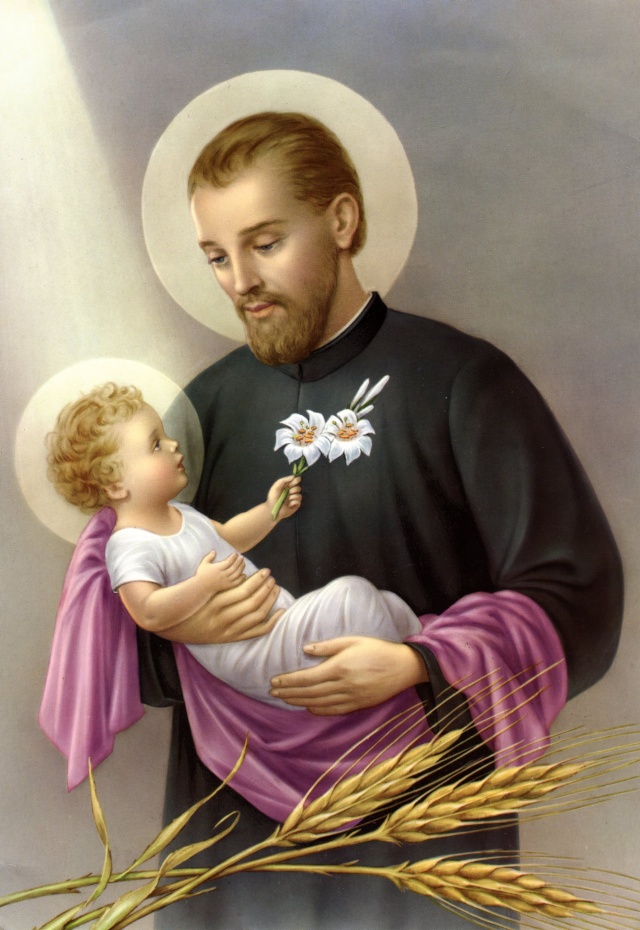
St. Cajetan


St. Cajetan feast day august 7

                     Feast of Saint Cajetan – Confessor
St. Cajetan was born in 1480 in Lombardy, of pious and noble parents. From childhood he was known as a saint and in later years as “a hunter of souls.” Even before St. Ignatius he undertook to establish a body of Clerks Regular following the apostolic life. Together with Pietro Carafa, afterwards Pope Paul IV, he took the austere vow of entrusting himself entirely to Divine Providence and living solely on any alms which might be voluntarily given by the faithful. Christian Rome venerates him as one of her most distinguished citizens. He took a notable part in the reform of the Breviary under Clement VII. When celebrating Mass in St. Mary’s Major at the crib of Our Lord, he merited the grace of holding the divine Infant in his arms. Worn out with toil and sickness he went to his reward in 1547.

Saint Cajetan of Thienna, From the Liturgical Year
Cajetan appeared in all his zeal for the sanctuary at the time when the false reform was spreading rebellion throughout the world. The great cause of the danger had been the incapacity of the guardians of the holy City, or their connivance by complicity of heart or of mind with pagan doctrines and manners introduced by an ill-advised revival. Wasted by the wild boar of the forest, could the vineyard of the Lord recover the fertility of its better days? Cajetan learned from Eternal Wisdom the new method of culture required by an exhausted soil.
The urgent need of those unfortunate times was that the clergy should be raised up again by worthy life, zeal, and knowledge. For this object men were required, who being clerks themselves in the full acceptation of the word, with all the obligations it involves, should be to the members of the holy hierarchy a permanent model of its primitive perfection, a supplement to their shortcomings, and a leaven, little by little raising the whole mass. But where, save in the life of the counsels with the stability of its three vows, could be found the impulse, the power, and the permanence necessary for such an enterprise? The inexhaustible fecundity of the religious life was no more wanting in the Church in those days of decadence than in the periods of her glory. After the monks, turning to God in their solitudes and drawing down light and love upon the earth seemingly so forgotten by them; after the mendicant Orders, keeping up in the midst of the world their claustral habits of life and the austerity of the desert: the regular clerks entered upon the battle-field, whereby their position in the fight, their exterior manner of life, their very dress, they were to mingle with the ranks of the secular clergy; just as a few veterans are sent into the midst of a wavering troop, to act upon the rest by word and example and dash.
Like the initiators of the great ancient forms of religious life, Cajetan was the Patriarch of the Regular Clerks. Under this name Clement VII., by a brief dated 24th June, 1524, approved the institute he had founded that very year in concert with the Bishop of Theati, from whom the new religious were also called Theatines. Soon the Barnabites, the Society of Jesus, the Somasques of St. Jerome Emilian, the Regular Clerks Minor of St. Francis Carracciolo, the Regular Clerks ministering to the sick, the Regular Clerks of the Pious Schools, the Regular Clerks of the Mother of God, and others, hastened to follow in the track, and proved that the Church is ever beautiful, ever worthy of her Spouse; while the accusation of barrenness hurled against her by heresy, rebounded upon the thrower.
Cajetan began and carried forward his reform chiefly by means of detachment from riches, the love of which had caused many evils in the Church. The Theatines offered to the world a spectacle unknown since the days of the Apostles; pushing their zeal for renouncement so far as not to allow themselves even to beg, but to rely on the spontaneous charity of the faithful. While Luther was denying the very existence of God’s Providence, their heroic trust in It was often rewarded by prodigies.

Cajetan was born at Vicenza of the noble house of Thienna, and was at once dedicated by his mother to the Virgin Mother of God. His innocence appeared so wonderful from his very childhood that everyone called him “the “Saint.” He took the degree of Doctor in canon and civil law at Padua, and then went to Rome where Julius II. made him a Prelate. When he received the priesthood, such a fire of divine love was enkindled in his soul, that he left the court to devote himself entirely to God. He founded hospitals with his own money and himself served the sick, even those attacked with pestilential maladies. He displayed such unflagging zeal for the salvation of his neighbor that he earned the name of the “Hunter of souls.” 
His great desire was to restore Ecclesiastical discipline, then much relaxed, to the form of the Apostolic life, and to this end he founded the Order of Regular Clerks. They lay aside all care of earthly things, possess no revenues, do not beg even the necessaries of life from the faithful, but live only on alms spontaneously offered. Clement VII. having approved this institution, Cajetan made his solemn vows at the High Altar of the Vatican basilica, together with John Peter Caraffa, Bishop of Chieti, who was afterwards Pope Paul IV., and two other men of distinguished piety. During the sack of Rome, he was most cruelly treated by the soldiers, to make him deliver up his money, which the hands of the poor had long ago carried into the heavenly treasures. He endured with the utmost patience stripes, torture, and imprisonment. He persevered unfalteringly in the kind of life he had embraced, relying entirely upon Divine Providence: and God never failed him, as was sometimes proved by miracle.
St. Cajetan
He was a great promoter of assiduity at the divine worship, of the beauty of the House of God, of exactness in holy ceremonies, and of the frequentation of the most Holy Eucharist. More than once he detected and foiled the wicked subterfuges of heresy. He would prolong his prayers for eight hours, without ceasing to shed tears; he was often rapt in ecstasy and was famous for the gift of prophecy. At Rome, one Christmas night, while he was praying at our Lord’s crib, the Mother of God was pleased to lay the Infant Jesus in his arms. He would spend whole nights in chastising his body with disciplines, and could never be induced to relax anything of the austerity of his life: for he would say, he wished to die in sackcloth and ashes. At length he fell into an illness caused by the intense sorrow he felt, at seeing the people offend God by a sedittion; and at Naples, after being refreshed by a heavenly vision, he passed to heaven. His body is honored with great devotion in the Church of St. Paul in that town. As many miracles worked by him both living and dead made his name illustrious, Pope Clement X. enrolled him amongst the Saints.
Who has ever obeyed so well as thou, O great Saint, that word of the Gospel: Be not solicitous therefore saying: What shall we eat? or what shall we drink? or wherewith shall we be clothed (St. Matth. vi. 31)? Thou didst understand, too, that other divine word: The workman is worthy of his meat (Ibid. x. 10. 3), and thou knewest that it applied principally to those who labor in word and doctrine (1 Tim. v. 17.). Thou didst not ignore the fact that other sowers of the word had before thee founded on that saying the right of their poverty, embraced for God’s sake, to claim at least the bread of alms. Sublime right of souls eager for opprobrium in order to follow Jesus and to satiate their love! But Wisdom, who gives to the desires of the Saints the bent suitable to their times, caused the thirst for humiliation to be overruled in thee by the ambition to exalt in thy poverty the holy Providence of God; this was needed in an age of renewed paganism, which, even before listening to heresy, seemed to have ceased to trust in God. Alas! even of those to whom the Lord had given himself for their possession in the midst of the children of Israel, it could be truly said that they sought the goods of this world like the heathen. It was thy earnest desire, O Cajetan, to justify our Heavenly Father and to prove that He is ever ready to fulfil the promise made by His adorable Son: Seek ye therefore the kingdom of God, and His justice, and all these things shall be added unto you (St. Matth. vi. 33).
Circumstances obliged thee to begin in this way the reformation of the sanctuary, whereunto thou wert resolved to devote thy life. It was necessary, first, to bring back the members of the holy militia to the spirit of the sacred formula of the ordination of clerks, when, laying aside the spirit of the world together with its livery, they say in the joy of their hearts: “The Lord is the portion of my inheritance and of my cup: it is Thou, O Lord, that wilt restore my inheritance to me (Ps. xv. 5).”
The Lord, O Cajetan, acknowledged thy zeal and blessed thine efforts. Preserve in us the fruit of thy labour. The science of sacred rites owes much to thy sons; may they prosper, in renewed fidelity to the traditions of their father. May thy patriarchal blessing ever rest upon the numerous families of Regular Clerks which walk in the footsteps of thine own. May all the ministers of holy Church experience the power thou still hast, of maintaining them in the right path of their holy state, or, if necessary, of bringing them back to it. May the example of thy sublime confidence in God, teach all Christians that they have a Father in heaven, whose Providence will never fail His children.
                         St Donatus –  Bishop and Martyr
                   St. Donatus 1
There is also a commemoration of St. Donatus, Bishop and Martyr who suffered martyrdom under Emperor Julian the Apostate, in 361. This Bishop of Arezzo in Tuscany was illustrious for his sanctity and for his gift of working miracles. The Church has always remembered him with the highest veneration.                      
Thursday in the eighth week after Pentecost –  Feast of Saint Cajetan / Commemoration: St Donatus, Bishop and Martyr –  Missa ‘Sacerdotes Dei’
St Cajetan curing plague victims, 17th century
 Double/White                                                  Missa “Os justi”
INTROIT: Psalm 76: 19
The mouth of the just man shall meditate wisdom and his tongue shall speak judgment: the law of his God is in his heart.
Ps. 36: 1 –  Be not emulous of evil-doers; nor envy them that work iniquity. Glory be to the Father and to the Son and to the Holy Ghost, as it was in the beginning, is now and ever shall be, world without end.

COLLECT
O God, Who didst give to Blessed Cajetan, Thy confessor, the grace to imitate the apostolic way of life, grant us by his intercession and example ever to trust in Thee and to desire only heavenly things. Through the same Lord Jesus Christ, Thy Son, Who liveth and reigneth with Thee in the unity of the Holy Ghost, God, Forever and ever.
Commemoration of St. Donatus
Let us pray. God, the glory of Thy priests, grant, we beseech Thee, that we may experience the assistance of Thy holy martyr and bishop, Donatus, whose festival we celebrate. Through our Lord Jesus Christ, Thy Son, Who liveth and reigneth with Thee in the unity of the Holy Ghost, one God
EPISTLE: Ecclus. 31: 8-11
Lesson from the Book of Wisdom. Blessed is the man that is found without blemish, and that hath not gone after gold, nor put his trust in money nor in treasures. Who is he, and we will praise him? For he hath done wonderful things in his life. Who hath been tried thereby, and made perfect, he shall have glory everlasting: he that could have transgressed, and hath not transgressed, and could do evil things,and hath not done them: therefore are his goods established in the Lord, and all the church of the saints shall declare his alms.
holy sacrifice of the mass propers
GRADUAL: Psalm 91: 13, 14
The just shall flourish like the palm-tree; he shall grow up like the cedar of Libanus in the house of the Lord.
To show forth Thy mercy in the morning, and Thy truth in the night.
ALLELUIA: James 1: 12
Blessed is the man that endureth temptation; for when he hath been proved, he shall receive the crown of life. Alleluia, alleluia.

GOSPEL: Matthew 6: 24-33
At that time, Jesus said to His disciples: “No man can serve two masters for he will hate the one and love the other, or he will sustain the one and despise the other. You cannot serve God and mammon. Therefore I say to you, be not solicitous for your life, what you shall eat, nor for your body, what you shall put on. Is not the life more than the meat, and the body more than the raiment? Behold the birds of the air for they neither sow nor do they reap, nor gather into barns, and your heavenly Father feedeth them. Are you not of much more value than they? And which of you, by taking thought, can add to his stature one cubit? And for raiment, why are you solicitous? Consider the lilies of the field, how they grow; they labor not, neither do they spin but I say to you, that not even Solomon in all his glory was arrayed as one of these. Now if God so clothe the grass of the field, which is today, and tomorrow is cast in the oven, how much more you, O ye of little faith! Be not solicitous therefore saying: What shall we eat, or what shall we drink, or wherewith shall we be clothed? for after all these things do the heathen seek. For your Father knoweth that you have need of all these things. Seek ye therefore first the kingdom of God, and His justice and all these things shall be added unto you.”
OFFERTORY: Psalm 88: 25
Let us pray. My truth and My mercy shall be with him: and in My name shall his horn be exalted. 
SECRET
Grant, we beseech Thee, O almighty God, that our humble offerings may be both pleasing to Thee in honor of Thy saints and may cleanse us alike in body and soul. Through our Lord Jesus Christ, Thy Son, Who liveth and reigneth with Thee in the unity of the Holy Ghost, God, Forever and ever.
August 7  Miracle_of_Saint_Donatus
Commemoration Secret of St. Donatus
Let us pray. Grant, we beseech Thee, O Lord, that through the intercession of Thy holy bishop and martyr, Donatus, whom we venerate with the offerings dedicated to the praise of Thy name, the fruit of tender devotion may increase in us. Through our Lord Jesus Christ, Thy Son, Who liveth and reigneth with Thee in the unity of the Holy Ghost, one God Forever and ever.
PREFACE   Common Preface
It is truly meet and just, right and for our salvation that we should at all times and in all places, give thanks unto Thee, O holy Lord, Father almighty, everlasting God: through Christ our Lord. Through Whom the Angels praise Thy Majesty, the Dominations worship it, the Powers stand in awe. The Heavens and the Heavenly hosts together with the blessed Seraphim in triumphant chorus unite to celebrate it. Together with them we entreat Thee, that Thou mayest bid our voices also to be admitted, while we say in lowly praise:
HOLY, HOLY, HOLY…
COMMUNION:   Matthew 24: 46-47
Blessed is the servant, whom when the Lord shall come, He shall find watching: Amen I say to you, He shall set him over all his goods.
POSTCOMMUNION
We beseech Thee, O almighty God, that we, who have partaken of Heavenly nourishment, may, by the intercession of blessed Cajetan; Thy confessor, be fortified by it against all adverse influences Through our Lord Jesus Christ, Thy Son, Who liveth and reigneth with Thee in the unity of the Holy Ghost, God, For ever and ever.
Commemoration Postcommunion of St. Donatus
Let us pray. Almighty and merciful God, Who dost make us both the partakers and the ministers of Thy sacraments, grant, we beseech Thee, that, by the intercession of blessed Donatus, Thy martyr and bishop, we may profit both by our fellowship with him in faith and by our worthy service. Through our Lord Jesus Christ, Thy Son, Who liveth and reigneth with Thee in the unity of the Holy Ghost, one God
resist pope who openly destroys the church

St. Cajetan – “One must resist the pope who openly destroys the Church!!”

Dedication of the Church of Our Lady of the Snows


Our Lady of the Snows by Mathis Gothart Grünewald


       OUR LADY OF THE SNOW


Wednesday within the Tenth Week after the octave of Pentecost

      Greater – Double / White Vestments

        Missa “Salve sancta parens

INTROIT – Psalm 44:2

Hail, holy Mother, thou who didst bring forth the King who rules heaven and earth for ever and ever. (Ps. 44: 2) My heart hath uttered a good word: I speak my works to the King. V. Glory be to the Father and to the Son and to the Holy Ghost, as it was in the beginning, is now and ever shall be, world without end. Amen.

COLLECT

Grant us, we beseech Thee, O Lord God, to enjoy perpetual health of mind and body; and by the glorious intercession of blessed Mary ever Virgin, to be delivered from present sorrows and to enjoy everlasting gladness. Through Our Lord Jesus Christ: who liveth and reigneth with Thee in the unity of the Holy Ghost, one God…

EPISTLE – Eccles 24:14-16

Lesson from the Book of Wisdom

From the beginning, and before the world, was I created, and unto the world to come I shall not cease to be; and in the holy dwelling place I have ministered before Him. And so I was established in Sion, and in the holy city likewise I rested, and my power was in Jerusalem. And I took root in an honourable people, and in the portion of my God, his inheritance; and my abode is in the full assembly of saints.

GRADUAL

Thou art blessed and venerable, O Virgin Mary, who, with purity unstained, was found to be the Mother of our Saviour. Virgin Mother of God, He whom the whole world was unable to contain enclosed Himself in thy womb, being made man.

Alleluia

Alleluia, alleluia. After childbirth, thou didst remain a virgin, O Mother of God; intercede for us. Alleluia.

GOSPEL – Luke 11: 27-28

The continuation of the Holy Gospel according to Luke

At that time, as Jesus was speaking to the multitudes, a certain woman from the crowd, lifting up her voice, said to Him: ‘Blessed is the womb that bore Thee and the paps that gave Thee suck." But He said: “Yea, rather, blessed are they who hear the word of God and keep it.”’  

OFFERTORY

Hail Mary, full of grace, the Lord is with thee: blessed art thou among women, and blessed is the fruit of thy womb.


SECRET

Through thy mercy. O Lord, and the intercession of blessed Mary ever Virgin, may this oblation secure for us prosperity and peace both now and forever. Through our Lord.

PREFACE OF THE BLESSED VIRGIN MARY

It is truly meet and just, right and availing unto salvation, that we should at all times and in all places give thanks unto Thee, O holy Lord, Father almighty and everlasting God. That on the Festival of Our Lady of the Snow of the Blessed Virgin Mary, we should praise, bless, and proclaim Thee. For she conceived Thine only-begotten Son by the overshadowing of the Holy Ghost; and, losing not the glory of her virginity, gave forth to the world the everlasting light, Jesus Christ our Lord. Through whom the angels praise Thy majesty, the Dominions worship it, and the powers stand in awe. The Heavens and the heavenly Hosts, and the blessed Seraphim, join together in celebrating their joy. With these we pray Thee join our voices also, while we say with lowly praise:

SANCTUS

Sanctus, Sanctus, Sanctus Dóminus Deus Sábaoth. Pleni sunt cæli et terra glória tua. Hosánna in excélsis. Benedíctus qui venit in nómine Dómini. Hosánna in excélsis.

COMMUNION 

Blessed is the womb of the Virgin Mary, which bore the Son of the Eternal Father.

POSTCOMMUNION

Having received, O Lord, these helps to our salvation, grant, we beseech Thee, that we may be ever protected by the patronage of blessed Mary ever Virgin, in whose honor we have made these offerings to Thy majesty. Through the same Lord Jesus Christ, Thy Son, Who liveth and reigneth with Thee in the unity of the Holy Ghost, one God for ever and ever. Amen.


Exaltation of the Holy Cross Novena


 Exaltation of the Holy Cross Novena
       (September 5 – September 13)

Jesus, Who because of Your burning love
for us willed to be crucified and to shed
Your Most Precious Blood for the redemption
and salvation of our souls, look down upon
us and grant the petition we ask for...

          (Mention your request)

We trust completely in Your Mercy.
Cleanse us from sin by Your Grace, sanctify our work,give us and all those who are dear to us our daily bread, lighten the burden of our sufferings, bless our families, and grant to the nations, so sorely afflicted, Your Peace, which is the only true peace, so that by obeying Your Commandments we may come at last to the glory of Heaven. Amen.


ST. THOMAS AQUINAS, DOCTOR OF THE CHURCH

Triumph of St Thomas Aquinas over the Heretics by Filippino Lippi   
        
          ST. THOMAS AQUINAS 
       DOCTOR OF THE CHURCH

               The Liturgical Year
    Abbot Dom Guéranger, O.S.B. 
The saint we are to honour today is one of the sublimest and most lucid interpreters of divine truth. He rose up in the Church many centuries after the apostolic age, nay, long after the four great Latin doctors, Ambrose, Augustine, Jerome, and Gregory. The Church, the ever young and joyful mother, is justly proud of her Thomas, and has honoured him with the splendid title of the angelical doctor, on account of the extraordinary gift of understanding wherewith God had blessed him; just as his contemporary and friend, St. Bonaventure, has been called the seraphic doctor, on account of the wonderful unction which abounds in the writings of this worthy disciple of St. Francis. Thomas of Aquinas is an honour to mankind, for perhaps there never existed a man whose intellect surpassed his. He is one of the brightest ornaments of the Church, for not one of her doctors has equaled him in the clearness and precision wherewith he has explained her doctrines. He received the thanks of Christ Himself, for having well written of Him and His mysteries. How welcome ought this feast of such a saint to be to us during this season of the year, when our main study is our return and conversion to God! What greater blessing could we have than to come to the knowledge of God? Has not our ignorance of God, of His claims, and of His perfections, been the greatest misery of our past lives? Here we have a saint whose prayers are most efficacious in procuring for us that knowledge, which is unspotted, and converteth souls, and giveth wisdom to little ones, and gladdeneth the heart, and enlighteneth the eyes. Happy we if this spiritual wisdom be granted us! We shall then see the vanity of everything that is not eternal, the righteousness of the divine commandments, the malice of sin, and the infinite goodness where with God treats us when we repent.

     Let us learn from the Church the claims of the angelical doctor to our admiration and confidence.

     The distinguished ornament of the Christian world and light of the Church, the most blessed man Thomas, was born of noble parents, his father being Landulph, Count of Aquino, and his mother a rich Neapolitan lady, by name Theodora. While yet an infant he gave proof of his future devotion towards the Mother of God; for having found a leaflet on which was written the angelical salutation, he clenched it so fast that the nurse tried in vain to take it from his hand. His mother, however, having forced it from him, the child succeeded by tears and signs, in recovering the paper, which he immediately swallowed. When he was five years old he was sent to Monte Cassino, that he might receive from the Benedictine monks his first training. Thence he was sent to Naples, where he went through a course of studies, and, young as he was, joined the Order of Friars Preachers. This step caused great displeasure to his mother and brothers, and it was therefore deemed advisable to send him to Paris. He was waylaid by his brothers, who seized him, and imprisoned him in the castle of Saint John. After having made several unsuccessful attempts to induce him to abandon the holy life he had chosen, they assailed his purity, by sending to him a wicked woman: but he drove her from his chamber with a firebrand. The young saint then threw himself on his knees before a crucifix. Having prayed some time, he fell asleep, and it seemed to him that two angels approached him, and tightly girded his loins. From that time forward, he never suffered the slightest feeling against purity. His sisters also had come to the castle, and tried to make him change his mind; but he, on the contrary, persuaded them to despise the world, and devote themselves to the exercise of a holy life. It was contrived that he should escape through a window of the castle, and return to Naples. He was thence taken by John the Teutonic, the General of the Dominican Order, first to Rome and then to Paris, in which latter city he was taught philosophy and theology by Albert the Great. At the age of twenty-five, he received the title of doctor, and explained in the public schools, and in a manner that made him the object of universal admiration, the writings of philosophers and theologians. He always applied himself to prayer, before reading or writing anything. When he met with any difficult passage in the sacred Scriptures, he both fasted and prayed. He used often to say to his companion, Brother Reginald, that if he knew anything, it was more a gift from God, than the fruit of his own study and labour. One day, when at Naples, as he was praying with more than his usual fervor, before a crucifix, he heard these words: ‘Well hast thou written of me, Thomas! What reward wouldst thou have me give thee?’ He answered: ‘None other, Lord, than thyself.’
     His favourite spiritual book was the Conferences of the Fathers, and there was not a book which he had not most carefully read. His writings are so extraordinary, not only for their number and variety, but also for their clearness in explaining difficult points of doctrine, that his copious and sound teaching, so wonderfully consonant with revealed truth, is most apt for utterly refuting the errors of all ages. Being called to Rome by Pope Urban IV., he composed, at his command, the ecclesiastical Office for the solemnity of Corpus Christi; but he refused to accept any honours, as likewise the archbishopric of Naples offered to him by Pope Clement IV. He was most zealous in preaching the word of God. On one occasion, during Easter week, as he was preaching in the church of St. Peter, a woman touched the hem of his habit, and was cured of an issue of blood. He was sent by Gregory X. to the Council of Lyons; but having reached Fossa Nova, he fell sick, and was received as a guest in the monastery of that place, where he wrote a commentary on the Canticle of Canticles. There he died in the fiftieth year of his age, in the year of our Lord 1274 on the Nones of March (March 7). His sanctity was made manifest after his death, by miracles: which being proved, he was canonized by Pope John XXII. in the year 1323. His body was translated to Toulouse by command of blessed Urban V. Being comparable to the angels, no less by his innocence than by his genius, he has received the title of angelical doctor, confirmed to him by the authority of St. Pius V. Pope Leo XIII. joyfully acceding to the desires and petitions of the bishops of the Catholic world, by a decree of the sacred Congregation of rites and by letters apostolic, ordained and declared him the heavenly patron of all Catholic schools; and this especially for the purpose of repelling the evil of so many philosophical systems abandoned to error, for the increase of knowledge, and for the common utility of mankind.


St. Thomas Aquinas kneeling and offering his works to the Roman Catholic Church

     How shall we worthily praise thee, most holy Doctor! How shall we thank thee for what thou hast taught us? The rays of the divine Sun of justice beamed strongly upon thee, and thou hast reflected them upon us. When we picture thee contemplating truth, we think of those words of our Lord: Blessed are the clean of heart, for they shall see God. Thy victory over the concupiscence of the flesh merited for thee the highest spiritual delights; and our Redeemer chose thee, because of the purity of thy angelic soul, to compose for His Church the Office whereby she should celebrate the divine Sacrament of His love. Learning did not impair thy humility. Prayer was ever thy guide in thy search after truth; and there was but one reward for which, after all thy labours, thou wast ambitious, the possession of God.
     Thy life, alas was short. The very master-piece of thy angelical writings was left unfinished. But thou hast not lost thy power of working for the Church. Aid her in her combats against error. She holds thy teachings in the highest estimation because she feels that none of her saints has ever known so well as thou, the secrets and mysteries of her divine Spouse. Now, perhaps more than in any other age, truths are decayed among the children of men; strengthen us in our faith, get us light. Check the conceit of those shallow self-constituted philosophers, who dare to sit in judgment on the actions and decisions of the Church, and to force their contemptible theories upon a generation that is too ill-instructed to detect their fallacies. The atmosphere around us is gloomy with ignorance; loose principles, and truths spoilt by cowardly compromise, are the fashion of our times; pray for us; bring us back to that hold and simple acceptance of truth, which gives life to the intellect and joy to the heart.
     Pray, too, for the grand Order which loves thee so devoutly, and honours thee as one of the most illustrious of its many glorious children. Draw down upon the family of thy patriarch St. Dominic the choicest blessings, for it is one of the most powerful auxiliaries of God’s Church.

     We are on the eve of the holy season of Lent, preparing for the great work of earnest conversion of our lives. Thy prayers must gain for us the knowledge both of the God we have offended by our sins, and of the wretched state of a soul that is at enmity with its Maker. Knowing this, we shall hate our sins; we shall desire to purify our souls in the Blood of the spotless Lamb; we shall generously atone for our faults by works of penance.


Eleison Comments by Mgr. Williamson - Number CDXCVIII (498)


                    Benevolent Ally?

    A V II bishop wishes Tradcats well? –
  But can he see how V II leads to Hell?

Bishop Athanasius Schneider, originally from Germany but now a Bishop of Astana in Kazakhstan, has made himself known to Traditionalists in recent years for his many statements at least apparently sympathetic to Catholic Tradition. For instance last year he associated himself publicly with the four Cardinals’ questioning of Pope Francis’ doctrine in the papal document, Amoris Laetitia. When he himself does so much to criticize the Church swinging “left,” he may not understand or appreciate coming under attack from the “right,” but it is the Truth which is at stake, not our little personalities. Your Excellency, thank you for much truth that you have had the courage openly to defend, but do understand that the full Truth is much stronger, and more demanding, than you think. You gave recently an interview to Adelante la Fe. Please do not take it personally if I quote (in italics) a few of your answers and criticize them:—
I am convinced that in the present circumstances, Msgr. Lefebvre would accept Rome’s canonical proposal of a Personal Prelature without hesitation. Your Excellency, that is impossible. Archbishop Lefebvre believed, and proved by argument from Church theology and history, that Vatican II was an unprecedented betrayal, by the highest authorities in the Church, of 1900 years of unchangeable Church doctrine. But official Rome is still following that objectively treacherous Council. Therefore to put the SSPX under this Rome will be to put the fox in charge of the hen-coop. The Archbishop always hoped Rome would come right. It has still not done so.
Msgr. Lefebvre was a man with a deep ”sensus ecclesiae,” or sense of the Church. That is true, because above all he had a deep and clear grasp of Catholic doctrine, or teaching, which is at the heart of the Church. “Going, TEACH all nations,” was Jesus’ last instruction to his Apostles (Mt. XXVIII , 20). Vatican II betrayed Catholic doctrine, so the Archbishop’s very sense of the Church made him repudiate that Council. Today’s Conciliarists in Rome can never rebuild the Church.
He consecrated four bishops in 1988 because he was convinced that there was a real state of necessity. It was the objective crisis that gave rise to the subjective conviction, and not the other way round. Our modern world is mentally sick with subjectivism. The Archbishop was an objectivist.
If the SSPX remains canonically independent for too long, its members and followers will lose their sense of the need to be subject to the Pope, and they will end up ceasing to be Catholic. The Pope is Pope in order to “confirm his brethren” in the Faith. See Luke XXII, 32. If he is a Conciliar Pope with his faith corrupted by Vatican II, he can no longer give what he has not got. It is by being subject to Conciliar Popes that countless Catholics since the Council have lost the true Faith.
No Catholic can pick and choose which Popes he will or will not be subject to. God guides His Church. The present crisis in the Church is unprecedented because never before in Church history has there been a series of Popes out of line with the true Faith as we have seen since Vatican II. This means that Catholics must – exceptionally – judge their Popes, bishops and priests. By this crisis God is purifying His Church, and when the purification is complete, He will grant to His Church a great and truly Catholic Pope.
I have told Bishop Fellay, we in Rome need the SSPX in today’s great battle for the purity of the Faith. Your Excellency, do believe that Conciliar Rome will do its best to complete the SSPX’s corruption of the Faith. Already the official SSPX has slidden far from the Archbishop’s objective Faith.
Kyrie eleison.


Eleison Comments - Number CDXCV (495)


              Vatican “War”

To Vatican Two will Catholics wake up ever?
They surely wake up better late than never!

In today’s crisis of the Church, of an unprecedented gravity in all Church history, it is most important that Catholics should give due importance both to the Traditional movement and to the Catholic Church outside the Traditional movement. Tradition in its broadest sense, meaning everything which Our Lord entrusted to his Church to be handed down ( tradendum in Latin) to world’s end, is indispensable to the Church, and the Traditional movement has played an indispensable part in preserving Traditional doctrine and sacraments from their destruction by the Conciliar Revolution over the last half-century. But to survive, the Traditional movement had to place itself outside the normal hierarchical structure of the Church, and that structure is very much part of Tradition – “Peter, feed my sheep” (Jn XXI, 17). Therefore however deep is the Conciliar corruption in Rome, Catholics must still be looking to Rome.

Hence the interest of the following report from inside Rome by the Founder and Director of an American Novus Ordo publication, LifeSiteNews. Steve Jalsevac normally visits Rome twice a year with colleagues to talk with all kinds of contacts in Rome, the better to be able to assess how the situation in the Church is developing. From his late November visit he published on December 16 a “deeply worrying” report of his impressions of the situation in Rome today. Extracts follow:

“Our Nov. 16–23 visit to Rome was the most dramatic of many such twice-per-year work trips we have taken there during the past 10 years. After meeting with cardinals, bishops and other Vatican agency and dicastery staff, our new Rome reporter John-Henry Westen, Jan Bentz, and I saw a consistent pattern of widespread anxiety and very real fear among faithful Church servants. We have never encountered this before. Many were afraid of being removed from their positions, fired from their jobs in Vatican agencies or of encountering severe public or private reprimands and personal accusations from those around the Pope or even from Francis himself. They are also fearful and anxious about the great damage being done to the Church and being helpless to stop it.

“. . .  Catholic universities in Rome are watched and professors’ lectures screened to ensure they fall in line with a liberal interpretation of Amoris Laetitia. Clerics are reported to Superiors if they are overheard expressing concerns about Pope Francis. Many are afraid to speak openly, even though in the past they were always very willing. Vatican reporters told us they were warned numerous times not to report on the dubia (the questions raised by Cardinal Burke and three other Cardinals as to doctrine contained in Amoris Laetitia). I have heard reports that the Vatican is like an occupied state. Certain sources I've spoken with have a fear that communications with Vatican officials are being monitored; some have even reported suspicious anomalies in their telephone conversations in which, after a dropped call, the audio of the last moments of their conversation has played over and over again on a loop, as though they are hearing a recording. Some individuals who work within the Vatican are advising their contacts on the outside not to share sensitive information via email or their Vatican-issued cell phones.

“We have to wonder where all of this is going. It is deeply, deeply concerning. The common phrase we kept hearing that week in Rome is that there is a “war” going on in the Church – a war of the “The Spirit of Vatican II” progressives against the orthodox Catholics. One person after another shockingly used the word “war.” I have never experienced anything like this in my lifetime and I am sure most, if not all regular LifeSite readers, can say the same thing.”

Traditionalists may say that the four Cardinals and Mr Jalsevac are victims of Vatican II, waking up a little late, but let nobody say that they do not mean or intend to be Catholic. The Church will only be healed when true Doctrine and the true Hierarchy come together again, so let Traditionalists pray urgently for these souls waking up to the Conciliar war. May God give them light and strength.

Kyrie eleison.