Extra Ecclesiam Nulla Salus

Extra Ecclesiam Nulla Salus
St. Alphonsus Maria de Liguori, ora pro nobis!

Obama Christmas greetings: Christ taught us to be our brother's keeper and our sister's keeper


Obama and Other World Leaders Send Christmas Greetings


Posted by 
It is Christmas Day, and political leaders around the world have broadcast or posted holiday greetings. From the White House, Christmas greetings come from President Obama in his Weekly Address, saying in part:
So many people all across the country are helping out at soup kitchens, buying gifts for children in need, or organizing food or clothing drives for their neighbors.  For families like ours, that service is a chance to celebrate the birth of Christ and live out what He taught us – to love our neighbors as we would ourselves; to feed the hungry and look after the sick; to be our brother’s keeper and our sister’s keeper.
Other world leaders have also sent Christmas greetings to their nations and the world.  Here are Christmas greetings from Canada's Prime Minister Stephen Harper. According to The Guardian, Queen Elizabeth's annual Christmas broadcast this afternoon will include  behind-the-scenes video filmed after the christening of Prince George of Cambridge. The Times of Israel reprints part of Israeli Prime Minister Benjamin Netanyahu's Christmas greetings to Christians around the world.Associated Press of Pakistan reprints the Christmas greetings sent by Pakistani President Mamnoon Hussain.  And from a not-quite head of state, here is a Christmas and New Year message from Maryam Rajavi, President elect of National Council of Resistance of Iran.

http://religionclause.blogspot.ca/2013/12/obama-and-other-world-leaders-send.html

Russia's Putin: "We need to go back to our traditional values, and based on them to move forward"


Putin: Russia socially and spiritually based on traditional values

President Vladimir Putin once again confirmed that Russia will socially and spiritually be based on traditional values, during a final press conference which was expected both in Russia and worldwide. The news was reported by the press service of “TBN Russia.”
“Russia is a country with deep and ancient culture, and without relying on the traditional values of society it has been degrading, so we need to go back to them and based on them to move forward ... Our job is to protect the population from the so-called quasi-values by the aggressive behavior of some social groups that impose their own culture, and who live how they want to, and are not easily accepted by our citizens,” said Putin, answering on a question from CNN.
Most local and foreign media, including the media holding «RBN», quickly responded to Putin's speech and supported the Russian president on this issue.
“We have seen once again that our president is not only the political, but also the spiritual leader of such a vast country like Russia, with centuries-old way of life, in which morality, rectitude and family has always been the main things. Vladimir Putin does not only offer our lives to be based on traditional values, but clarifies the consequences of liberalism in society already existing in Western countries,” said Alexander Belov, a board member of the media holding «RBN».
Public TV “TBN- Russia,” which is part of «RBN», also talks with great satisfaction of the permanent position of Russia on behalf of its president.

http://www.christiantelegraph.com/issue22087.html

POPE FRANCIS PRAISES THE TRASH PICKERS


POPE FRANCIS PRAISES THE TRASH PICKERS OF ARGENTINA


Pope Francis Praises ‘Trash Pickers’ Saying Recycling Is Good For Environment, For Workers (VIDEO)

Image
VATICAN CITY (AP) — Pope Francis has made an amateur video praising the world’s “cartoneros” — the poor people who pick through garbage to find recyclable and reusable goods. He says their work is dignified and good for the environment.
Francis recorded the video Dec. 5 while meeting with members of the Excluded Workers’ Movement of his native Argentina, which released the video this week at an annual meeting of trash recyclers.
Francis, known for his simple habits, has denounced today’s “throw-away culture” and said in the video that food that is tossed aside each day could feed all the world’s hungry.
Francis has a long relationship with Argentina’s “cartoneros” — literally “cardboard people.” He would celebrate Mass for them as archbishop and invited them on stage during World Youth Day in July.

A Christian Refusing to Serve Others Is ‘Pagan’

Daily News

Pope: A Christian Refusing to Serve Others Is ‘Pagan’ (702)

The Holy Father asked the crowds in St. Peter’s also to repeat with him, “Jesus is God with us.”


Kyle Burkhart/CNA
– Kyle Burkhart/CNAVATICAN CITY — In his Wednesday morning general audience, Pope Francis stressed the importance of humility and service in the Christian life, telling Christians that they must imitate God’s example in lowering himself to become man.“It is an ugly thing when one sees a Christian who does not want to lower himself, who does not want to serve, a Christian who parades around everywhere. It’s terrible, no? That person isn’t a Christian: He is a pagan,” the Pope said on Dec. 18 in St. Peter’s Square. “The Christian serves [and] lowers himself.”
With Christmas approaching, Pope Francis focused on the great “gift” of God in sending his Son, who came humbly as a baby in Bethlehem.
“In Christmas, God reveals himself not as one who stands above and who dominates the universe, but as he who lowers himself,” explained the Holy Father.  
“God lowers himself, coming down to earth as little and poor, showing that in order to be similar to him we must not place ourselves above others, but rather lower ourselves, place ourselves in service, make ourselves small with the small, poor with the poor.”
The incarnation of God made man, encouraged Pope Francis, should be a model for every Christian.
“We must make it so that our brothers and sisters never feel alone,” he said. “Our presence in solidarity to their side expresses not only with words, but with the eloquence of gestures, that God is close to all.”
Moreover, Pope Francis added, God did not expect or demand perfection. “The presence of God in the midst of humanity is not carried out in an ideal, idyllic world, but in this real world, marked by many good and bad things, marked by division, cruelty, poverty, abuse and war,” noted the Pope.

Still, “[God] chose to live our history as it is, with all the weight of its limitations and dramas. In so doing, he demonstrated in an unparalleled way his merciful inclinations and overflowing love toward his human creatures.”
“Jesus is God with us,” said the Holy Father, then making the crowds repeat with him, “Jesus is God with us.”
During this time of Advent, Pope Francis asked the faithful to prepare their hearts for the birth of Jesus as a “celebration of faithfulness and of hope that overcomes uncertainty and pessimism.”
“This is the reason for our hope,” he explained, “God is with us, and God is still faithful to us.”


Read more: http://www.ncregister.com/daily-news/pope-a-christian-refusing-to-serve-others-is-pagan?

Magister on the "monocratic, centralizing form in which Francis is in fact governing the Church."


Magister on the “monocratic, centralizing form in which Francis is in fact governing the Church.”


ROME, December 18, 2013 – In an interview with Vatican Tornielli friend, “La Stampa” three days ago, Pope Francis is back on two points of the “Evangelii gaudium” which had aroused animated comments pros and cons. The first step is communion for divorced and remarried. The pope wanted to clarify that he was not referring to it when he spoke of communion in the apostolic exhortation “as spiritual food, to be considered a remedy and not a reward.” With that Francis was keen to distinguish themselves from those who had read his words as yet another “open” and had expressed publicly in favor of communion. Among which, from the past, the new secretary general of the Synod of Bishops Baldisseri Lorenzo and Cardinal Walter Kasper. The second caveat concerning its rejection of the economic theory of “derrame” – an expression translated into Italian as “favorable relapse” and in English with “trickle-down” – that “every economic growth, driven by the free market, is able to produce by itself a greater equity and social inclusion.” Pope Jorge Mario Bergoglio he said – “not as a coach” – he does not believe in validity of this theory. It thus rejected the criticism that had been leveled in particular by the American neo-conservative theologian Michael Novak, that would be understandable distrust of the pope “in a static system such as Argentina, without any mechanism for social mobility”, but not in the United States and other advanced capitalist countries, where “wealth flows from the bottom” and economic growth – if supported by the protection of basic rights and the care of the poor is typical of Jewish-Christian tradition – promotes the rise of the less well-off towards higher levels of life. Of the two explanations, the first tap one of the crucial points of the “Evangelii gaudium” where Francis promises more collegiality in the government of the Church, with greater powers given to the episcopal conferences. In a previous service, www . church has highlighted the novelty of this approach adopted by Pope Bergoglio respect to the line of his predecessors Karol Wojtyla and Joseph Ratzinger, both very resolute in countering the risk that the Church becomes “a kind of federation of national churches” > L ‘federalist option of the bishop of Rome Some prominent clerics have gone well beyond what was said and not said by Better World. For example, the archbishop Baldisseri – considered a protege of the Pope – has already given it for granted that “Francis wants a dynamic and permanent synod, how interplay between the center and the periphery.” Multiplying in Germany, on the part of bishops and cardinals weight of pronouncements in support of communion for divorced and remarried – which will be just one of the topics for discussion at the next synod – also seems to confirm this news. However, there are at least two elements, the pope Better World, which seem to orient in the opposite direction . *The first is a single member, centralizing, in which Francis is actually ruling the Church. Nominations more significant than the beginning of his pontificate, both in and out of the curia, they are all descended from the personal choices of Pope Bergoglio, sometimes without jumping the normal processes of consultation or disregarding the rules in force. For example, although the fundamental laws of the Governorate of Vatican City State permit that the Secretary General is a layman, the pope has not only promoted to this role a cleric, the Legionnaires of Christ Argentine Fernando VERGEZ Álzaga, very attached to him, but he also consecrated bishop and entrusted the pastoral care of the citizens of the small state, removing it to Cardinal Angelo Comastri, archpriest of the basilica of St. Peter and Vicar General for the Vatican City. In other cases Francis appointed people who are living the denial of its program of cleaning and reform of the curia. It has kept them in place despite all the warnings received to the contrary, even by ecclesiastical upright and secure his confidence: > Rich and Chaouqui, two enemies at home How to episcopal conferences, their autonomy and their weight are not growing but declining. Among those who had distinguished themselves in the final phase of the pontificate of Benedict XVI, just as the United States continues along the same route. L’Italian, the most linked to the See of Peter, is in disarray. Francis has deprived the Secretary-General Mariano Crusade and has confined to Latin America, a diocese of the third row. He removed the president, Cardinal Angelo Bagnasco, the role of a member of the Congregation for Bishops, by promoting in its place the archbishop of Perugia Gualtiero Bassetti, one of the three vice-presidents of the CEI, which happens to be in the good graces of the Pope instead. And now is preparing to appoint a new secretary, who will become the de facto number one in the conference, directly to him. Meanwhile, Bergoglio asked the IEC to decide whether it will elect itself the future president, or if you prefer to leave the appointment to the pope, as it has always been. In 1983, in the only previous consultation on them, the Italian bishops said in a majority in favor of the election.But this time, the humours circulating, it seems that most prefer to leave it to the pope Better World ‘task, in order to avoid the risk of colliding with him. conclave In the March summits of the CEI is spent in support of Cardinal Angelo Scola. And shortly after the ‘”habemus papam” spread by mistake a statement of praise for the successful election … Archbishop of Milan. Still afraid that the real gliel’abbia elected not forgiven. * The second element that seems to hold Pope Francis a strengthening of episcopal conferences, according to a government of the Church more “collegial”, has to do with ecclesiology. ”the universal Church can not be conceived as the sum of the particular Churches or as a federation of particular Churches. It is not the result of their communion, but in its essential mystery, it is a reality ontologically and temporally prior to every individual particular Church. “ So you are quoted Pope John Paul II and then Cardinal Ratzinger in a letter of 1992 the congregation for the Doctrine of the Faith, entitled “Communionis notio.” The letter was addressed to the bishops, and so he continued: ”In fact, ontologically, the Church as mystery, the Church is one and unique according to the Fathers, precedes creation, and gives birth to the particular Churches as daughters, is expressed in them, is the mother and not the product of the particular Churches. Moreover, temporally, the Church is manifested in the day of Pentecost in the community of one hundred and twenty gathered around Mary and the twelve Apostles, the only Church representatives and the founders of the local Churches, who have a mission-oriented world: from the Church speaks all languages. ”Since it originated and manifested universal, have arisen the different local Churches, as particular expressions of the one Church of Jesus Christ . Arising within and by the universal Church, in it and from it have their ecclesiology. Therefore, the formula of the Second Vatican Council: ‘The Church in and out of the Churches’ (Ecclesia in et ex Ecclesiis) is inseparable from this one: “The Churches in and with the Church” (Ecclesia in et ex Ecclesia). Clearly, the mysterious nature of this relationship between the universal Church and the particular Churches, which is not comparable to that between the whole and the parts in any group or society purely human. “ This letter gave an official capacity to the argument by Ratzinger in dispute that the opposed to fellow German theologian, later Cardinal Walter Kasper. Kasper supported the original simultaneity of the universal Church and the particular Churches and to Ratzinger saw at work “an attempt to theological restoration of Roman centralism.” While Ratzinger reproached Kasper reduce the Church to a sociological construction, endangering the unity of the Church and in particular the ministry of the Pope. dispute between the two cardinals theologians continued until 2001, with a final exchange of stockpiled in the journal of the Jesuits in New York, ” America. “ But he became pope, Ratzinger has returned to restate his thesis post-synodal apostolic exhortation “Ecclesia in the Middle East” in 2012: ”The universal Church is a reality prior to the particular Churches, which are born into and the universal Church. This truth faithfully reflects Catholic doctrine and particularly that of the Second Vatican Council. Begin to understand the hierarchical dimension of ecclesial communion and allows the rich diversity and legitimate the particular Churches to articulate always drive, the place where the particular gifts become a real asset to the universality of the Church. “And Better World? Elected him to the chair of Peter, gave the impression of wanting a more collegial governance of the Church. And in his first Angelus in St. Peter’s Square, on March 17, told the crowd that he had read a book with profit of Cardinal Kasper, “a theologian smart, a good theologian. “ Some joined the two and concluded that Pope Francis married Kasper positions in the relationship between the universal Church and the local Churches. was not the case. Kasper’s book read by the pope did not concern the ecclesiology but the mercy of God And as ecclesiology, the theologian always most admired and quoted by Better World is Henri De Lubac (1896-1991), a Jesuit cardinal and finally, in 1971, author of an essay entitled “Les Églises particulières dans l’Église Universelle “who claimed to twenty years in advance and almost in the same words the thesis of Ratzinger and the” Communionis notio. “ In the opinion of De Lubac “the universal Church is not at a later time for a ‘ Addition of particular Churches or their federation. “Neither episcopal collegiality must be translated into” ecclesiastical nationalism that usually accompany an equally nefarious doctrinal pluralism “and a subtraction of his authority to the pope. In the fifth chapter of “Les Églises particulières dans l’Église Universelle “De Lubac analysis applies to the episcopal conferences and gives them a basis not of doctrine but simply pragmatic, not by divine right but only of ecclesiastical law: “The conciliar Constitution ‘Lumen Gentium’ is as clear as possible, to this regard. Do not accept any mediation between the doctrinal particular Church and the universal Church. “ Pope Bergoglio is not a theologian., but these are his masters. 

Blessed Urban V

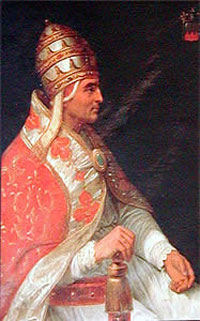
Pope Blessed Urban V

Guillaume de Grimoard, born at Grisac in Languedoc, 1310; died at Avignon, 19 December, 1370.
Pope Urban VBorn of a knightly family, he was educated at Montpellier and Toulouse, and became a Benedictine monk at the little priory of Chirac near his home. A Bull of 1363 informs us that he was professed at the great Abbey of St. Victor at Marseilles, where he imbibed his characteristic love for the Order of St. Benedict; even as pope he wore its habit. He was ordained at Chirac, and after a further course of theology and canon law at the universities of Toulouse, Montpellier, Paris, and Avignon, he received the doctorate in 1342. He was one of the greatest canonists of his day; was professor of canon law at Montpellier, and also taught at Toulouse, Paris, and Avignon; he acted successively as vicar-general of the Dioceses of Clermont and Uzès, was at an unknown date (before 1342) affiliated to Cluny, became prior of Notre-Dame du Pré (a priory dependent on St. Germain d’Auxerre), and in 1352 was named abbot of that famous house by Clement VI. With this date begins his diplomatic career. His first mission was to Giovanni Visconti, Archbishop and despot of Milan, and this he carried out successfully; in 1354 and 1360 he was employed on the affairs of the Holy See in Italy; in 1361 he was appointed by Innocent VI to the Abbacy of St. Victor at Marseilles, but in 1362 was once more dispatched to Italy, this time on an embassy to Joanna of Naples. It was while engaged on this business that the abbot heard of his election to the papacy.

THE MASSACRE AT ADRA

THE MASSACRE AT ADRA

 
 Image
 

Cardinal Burke fires warning shots

Cardinal Burke fires warning 

shots on behalf of tradition

Image
 
 
In his recent interview with Raymond Arroyo of EWTN, Cardinal Raymond Leo Burke fired two distinctive warning shots directly across the bow of the Good Ship Francis, even as most observers seem not to have noticed.
Much of the commentary concerning the interview seems to focus on two areas in particular, the first being Cardinal Burke’s insistence on the necessity of denying Holy Communion to pro-abortion politicians, a subject he has addressed any number of times in the past.
When news broke on Monday that the pope had not renewed Cardinal Burke’s membership in the Congregation for Bishops, and had newly appointed his polar opposite when it comes to placing Our Blessed Lord in the blood stained hands of pro-abortion politicians, Cardinal Wuerl of Washington, D.C., some posited that the interview had played a role in the move.
While I seriously doubt that this was the case as this decision was almost certainly made well before the interview, it is at one and the same time unsurprising and significant.
Secondly, a lot of attention has been given to Cardinal Burke’s reaction to the Holy Father’s statement that it’s not necessary to speak about issues such as abortion and homosexuality “all the time.”
“It’s a text that’s not altogether easy to interpret,” Burke said in the interview.
Now, let’s be clear, Cardinal Burke is not implying that there are issues regarding the way in which the comments were translated from Italian to English; rather, he is saying that it’s not easy to reconcile what the pope actually said with the concrete realities of the world in which we live when viewed in the light of Catholic teaching.
His Eminence explained:
“My response is what could be more essential than the natural moral law? In other words, these acts that are always and everywhere evil; they’re the first commands of our conscience, to respect human life, to respect the integrity of the family and to respect conscience. And so to me the pope can’t be saying… I can’t interpret that phrase of his as saying that these are not essentials,” he said.
“I’m not exactly sure why he mentioned it,” Cardinal Burke continued. “One gets the impression, or it’s interpreted in this way in the media, that he thinks we’re talking too much about abortion; too much about the integrity of marriage as between one man and one woman, but we can never talk enough about that.”
Even though many traditionalists were longing for Cardinal Burke to abandon all nuance in addressing the foibles of Francisco, one should appreciate the fact that, as far as “cardinal-speak” goes, these comments are about as close to a public rebuke of the pope as we’re going to get from the likes of Cardinal Burke, for the present moment anyway.
In time, I suspect, rebukes of this nature will become, by necessity, more plainly delivered, which brings me to the most significant, but largely overlooked, portions of the interview.
Warning shot number one:
When asked by Arroyo, “What has the ‘Francis Effect’ been from your vantage point, and what are you seeing among the Curia, particularly as he moves these reforms forward,” His Eminence took aim.
“I’ve made this statement, and I believe it is correct, I cannot imagine a reform of the Roman Curia that would not somehow be continuous withPastor Bonus, the Apostolic Constitution which has governed the Roman Curia since I think 1988, when Blessed John Paul II reformed the Roman Curia,” he said.
“Because the Church is an organic Body, and the service of the Roman Curia is part of the very nature of the Church, and so that has to be respected. And so I cannot imagine that somehow the Roman Curia is going to take on a completely different figure. It just doesn’t make sense.”
This, my friends, is a pretty clear warning shot from Cardinal Burke in the face of the Holy Father’s “synodal” aspirations. He is reminding all concerned that the Church’s hierarchical structure is not an extension of any given pope’s personal preference; rather, it’s reflective of her very essence.
In a very concrete way, Cardinal Burke is confronting – again, about as directly as one can expect at the present moment – the notion put forth by the Holy Father’s handpicked head of the so-called “C-8,” Cardinal Óscar Andrés Rodríguez Maradiaga, who said in a recent interview with Fr. Thomas Rosica, “[Pastor Bonus] is over, now it is something different. We need to write something different.”
 

Pope Shares Birthday Breakfast With Boy Band One Direction

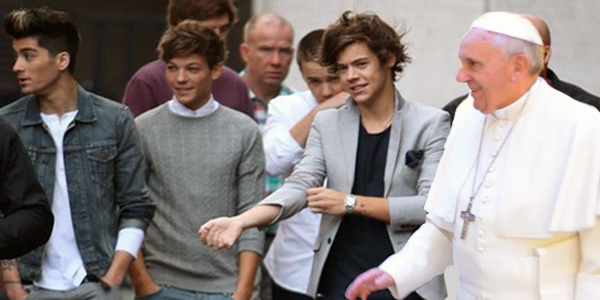
Pope Shares Birthday Breakfast With Boy Band One Direction


VATICAN–Five members of the English-Irish pop boy band One Direction helped Pope Francis celebrate his 77th birthday at the Vatican Tuesday. The teen heartthrobs, consisting of Niall Horan (the cute one), Zayn Malik (the quiet and mysterious one), Liam Payne (the sensible one), Harry Styles (the charming one), and Louis Tomlinson (the funny one), were invited by a Vatican official to attend the morning Mass which Francis celebrates daily at the hotel where he lives on Vatican City grounds, the Vatican said. One of the members of One Direction Niall Horan held his $14,000 Cavalier King Charles Spaniel as he was presented to Francis while the guests chatted following Mass. The Vatican also said Francis invited his household help to join him in what became a “discotech-like” atmosphere, and he spoke of them one by one during his homily. Francis, who is making history as one of the more informal and down-to-earth popes in recent times, struck a modest note as he reflected about people’s roles in the world. “Indeed, the Lord has given us all a role to play…but you are playing, perhaps, the most useless possible role in the history of mankind,” he said in his homily. “Seriously, look at you guys. Wait…are you even guys?” Francis went on to say that boy bands “should not even be a thing.” “Honestly, I was kind of confused when I met them,” Francis said  in an exclusive interview with EOTT. “I mean, have you seen these guys? At first I thought they were members of the Curia.”