Extra Ecclesiam Nulla Salus

Extra Ecclesiam Nulla Salus
St. Alphonsus Maria de Liguori, ora pro nobis!
Showing posts with label Dom Guéranger. Show all posts

AUGUST 10 - FEAST OF ST. LAURENCE, MARTYR

                    St. Laurence 

             Deacon and Martyr

             Abbot Dom Guéranger 

From the Liturgical Year, Volume XIII  


               FIRST VESPERS


Laurence has entered the lists as a martyr, and has confessed the name of our Lord Jesus Christ. Such is the antiphon wherewith the Church opens the first Vespers of the feast; and in fact, by this hour he has already entered the arena; with noble irony he has challenged the authorities, and has even shed his blood. On the very day of the martyrdom of Sixtus II, Cornelius Secularis, prefect of Rome, summoned Laurence before his tribunal, but granted him the delay necessary for gathering together the riches required by the imperial treasury. Valerian did not include the obscure members of the Church in his edicts of persecution; he aimed at ruining the Christians by prohibiting their assemblies, putting their chief men to death, and confiscating their property. This accounts for the fact that, on August 6, the faithful assembled in the cemetery of Praetextatus were dispersed, the pontiff executed, and the chief deacon arrested and ordered to deliver up the treasures which the Government knew to be in his keeping. 'Acknowledge my just and peaceable claims,' said the prefect. 'It is said that at your orgies your priests are accustomed, according to the laws of your worship, to make libations in cups of gold; that silver vessels smoke with the blood of the victims, and that the torches that give light to your nocturnal mysteries are fixed in golden candlesticks. And then you have such love and care for the brotherhood: report says you sell your lands in order to devote to their service thousands of sesterces; so that while the son is disinherited by his holy parents and groans in poverty, his patrimony is piously hidden away in the secrecy of your temples. Bring forth these immense treasures, the shameful spoils you have won by deceiving the credulous; the public good demands them; render to Caesar the things that are Caesar’s, that he may have' wherewith to fill his treasury and pay his armies.' Laurence, untroubled by these words, and as if quite willing to obey, gently answered: 'I confess you speak the truth; our Church is indeed wealthy; no one in the world, not even Augustus himself, possesses such riches. I will disclose them all to you, and I will show you the treasures of Christ. All I ask for is a short delay, which will enable me the better to perform what I have promised. For I must make an inventory of all, count them up, and value each article.' The prefect's heart swelled with joy, and gloating over the gold he hoped soon to possess, he granted him a delay of three days.
Meanwhile Laurence hastened all over the town and assembled the legions of poor whom their Mother the Church supported; lame and blind, cripple and beggars, he called them all. None knew them better than the archdeacon. Next he counted them, wrote down their names, and arranged them in long lines. On the appointed day he returned to the judge and thus addressed him: Come with me and admire the incomparable riches of the sanctuary of our, God.' They went together to the spot where the crowds of poor were standing, clothed in rags and filling the air with their supplications. 'Why do you shudder said Laurence to the prefect? 'Do you call that a vile and contemptible spectacle If you seek after wealth, know that the brightest gold is Christ, who is the light, and the human race redeemed by Him; for they are the sons of the light, all these who are shielded by their bodily weakness from the assault of pride and evil passion; soon they will lay aside their ulcers in the palace of eternal life, and will shine in marvellous glory, clothed in purple and bearing golden crowns upon their heads.
See, here is the gold which I promised you-gold of a kind that tire cannot touch or thief steal from you. Think not, then, that Christ is poor: behold these choice pearls, these sparkling gems that adorn the temple, these sacred virgins, I mean, and these widows who refuse second marriage; they form the priceless necklace of the Church, they deck her ears, they are her bridal ornaments, and win for her Christ's love.
Behold, then, all our riches; take them: they will beautify the city of Romulus, they will increase' the Emperor's treasures and enrich you yourself From a letter of Pope St. Cornelius, written a few years after these events, we learn that the number of widows and poor persons that the Church of Rome supported exceeded 1,500. By thus exhibiting them before the magistrate, Laurence knew that he endangered no one but himself, for the persecution of Valerian, as we have already observed, overlooked the inferior classes and attacked the leading members of the Church. Divine Wisdom thus confronted Caesarism and its brutality with Christianity which it so despised, but which was destined to overcome and subdue it. This happened on August 9, 258.
The first answer the furious prefect made was to order Laurence to be scourged and tortured upon the rack. But these tortures were only a prelude to the great ordeal he was preparing for the noble-hearted deacon. We learn this tradition from St. Damasus, for he says that, besides the flames, Laurence triumphed over 'blows, tortures, torments, and chains. We have also the authority of the notice inserted by Ado of Vienne in his Martyrology in the ninth century, and taken from a still more ancient source. The conformity of expression proves that it was partly from this same source that the Gregorian Antiphonal had already taken the Antiphons and Responsories of the feast. Besides the details which we learn from Prudentius and the Fathers, this office alludes to the converts Laurence made while in prison, and to his restoring sight to the blind. This last seems to have been the special gift of the holy deacon during the days preceding his martyrdom.

The August sun has set behind the Vatican, and the life and animation, which his burning heat had stilled for a time, begin once more upon the seven hills. Laurence was taken down from the rack about midday. In his prison, however, he took no rest, but wounded and bleeding as he was, he baptized the converts won to Christ by the sight of his courageous suffering. He confirmed their faith, and fired their souls with a martyr's intrepidity. When the evening hour summoned Rome to its pleasures, the prefect recalled the executioners to their work, for a few hours' rest had sufficiently restored their energy to enable them to satisfy his cruelty. Surrounded by this ill-favoured company, the prefect thus addressed the valiant deacon:
Sacrifice to the gods, or else the whole night long shall be witness of your torments.’
My night has no darkness,' answered Laurence, 'and all things are full of light to me.' They struck him on the mouth with stones, but he smiled and said: 'I give Thee thanks, O Christ.' Then an iron bed or gridiron with three bars was brought in and the saint was stripped of his garments and extended upon it while burning coals were placed beneath it. As they were holding him down with iron forks, Laurence said: 'I offer myself as a sacrifice to God for an odour of sweetness.' The executioners continually stirred up the fire and brought fresh coals, while they still held him down with their forks. Then the saint said: 'Learn, unhappy man, how great is the power of my God; for your burning coals give me refreshment, but they will be your eternal punishment.
I call Thee, O Lord, to witness: when I was accused, I did not deny Thee; when I was questioned, I confessed Thee, O Christ; on the red-hot coals I gave Thee thanks.' And with his countenance radiant with heavenly beauty, he continued: Yea, I give Thee thanks, O Lord Jesus Christ, for that Thou hast deigned to· strengthen me.' He then raised his eyes to his judge, and said: 'See, this side is well roasted; turn me on the other and eat.' Then continuing his canticle of praise to God: 'I give Thee thanks, O Lord, that I have merited to enter into Thy dwelling-place.  As he was on the point of death, he remembered the Church. The thought of the eternal Rome gave him fresh strength, and he breathed forth this ecstatic prayer: 'O Christ, only God, O Splendour, O Power of the Father, O Maker of heaven and earth and builder of this city's walls. Thou hast placed Rome's sceptre high over all; Thou hast willed to subject the world to it, in order to unite under one law the nations which differ in manners, customs, language, genius, and sacrifice. Behold the whole human race has submitted to its empire, and all discord and dissensions disappear in its unity. Remember thy purpose: Thou didst will to bind the immense universe together into one Christian Kingdom. O Christ, for the sake of Thy Romans, make this city Christian; for to it Thou gavest the charge of leading all the rest to sacred unity. All its members in every place are united-a very type of Thy Kingdom; the conquered universe has bowed before it. Oh may its royal head be bowed in turn Send Thy Gabriel and bid him heal the blindness of the sons of lulus that they may know the true God. I see a prince who is to come-an Emperor who is a servant of God. He will not suffer Rome to remain a slave; he will close the temples and fasten them with bolts for ever.' Thus he prayed, and with these last words he breathed forth his soul.

Some noble Romans who had been conquered to Christ by the martyr's admirable boldness, removed his body: the love of the most high God had suddenly filled their hearts and dispelled their former errors.
From that day the worship of the infamous gods grew cold; few people went now to the temples, but hastened to the altars of Christ. Thus Laurence, going unarmed to the battle, had wounded the enemy with his own swords. The Church, which is always grateful in proportion to the service rendered her, could not forget this glorious night.
At the period when her children's piety vied with her own, she used to summon them together at sunset on the evening of August 9 for a first Night Office. At midnight the second Matins began, followed by the first Mass called 'of the night or of the early morning. Thus the Christians watched around the holy deacon during the hours of his glorious combat. 'O God, Thou hast proved my heart, and visited it by night, Thou hast tried me by fire, and iniquity hath not been found in me. Hear. O Lord, my justice; attend to my supplication. Such is the grand Introit which immediately after the night Vigils, hallowed the dawn of August I0, at the very moment when Laurence entered the eternal sanctuary to fulfil his office at the heavenly altar. Later on certain churches observed on this feast a custom similar to one in use at the Matins of the commemoration of St. Paul; it consisted in reciting a particular versicle before repeating each antiphon of the Nocturns.

The doctors of the sacred liturgy tell us that the remarkable labours of the Doctor of the Gentiles and those of St. Laurence earned for them this distinction. Our forefathers were greatly struck by the contrast between the endurance of the holy deacon under his cruel tortures and his tender-hearted, tearful parting with Sixtus II three days before. On this account, they gave to the periodical showers of 'falling stars,' which occur about August 10, the graceful name of St. Laurence's tears: a touching instance of that popular piety which delights in raising the heart to God through the medium of natural phenomena.

St. Cajetan


St. Cajetan feast day august 7

                     Feast of Saint Cajetan – Confessor
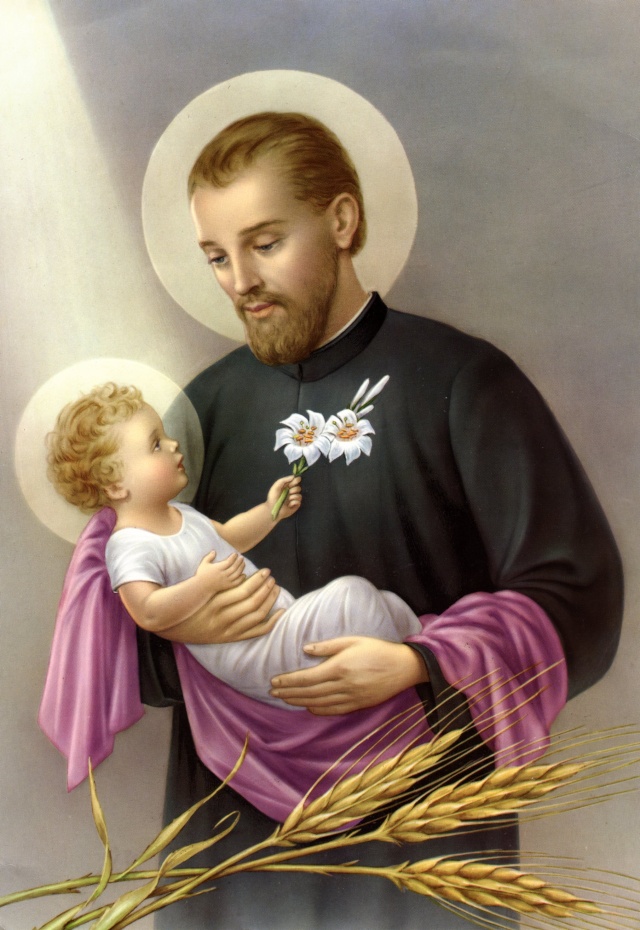
St. Cajetan was born in 1480 in Lombardy, of pious and noble parents. From childhood he was known as a saint and in later years as “a hunter of souls.” Even before St. Ignatius he undertook to establish a body of Clerks Regular following the apostolic life. Together with Pietro Carafa, afterwards Pope Paul IV, he took the austere vow of entrusting himself entirely to Divine Providence and living solely on any alms which might be voluntarily given by the faithful. Christian Rome venerates him as one of her most distinguished citizens. He took a notable part in the reform of the Breviary under Clement VII. When celebrating Mass in St. Mary’s Major at the crib of Our Lord, he merited the grace of holding the divine Infant in his arms. Worn out with toil and sickness he went to his reward in 1547.

Saint Cajetan of Thienna, From the Liturgical Year
Cajetan appeared in all his zeal for the sanctuary at the time when the false reform was spreading rebellion throughout the world. The great cause of the danger had been the incapacity of the guardians of the holy City, or their connivance by complicity of heart or of mind with pagan doctrines and manners introduced by an ill-advised revival. Wasted by the wild boar of the forest, could the vineyard of the Lord recover the fertility of its better days? Cajetan learned from Eternal Wisdom the new method of culture required by an exhausted soil.
The urgent need of those unfortunate times was that the clergy should be raised up again by worthy life, zeal, and knowledge. For this object men were required, who being clerks themselves in the full acceptation of the word, with all the obligations it involves, should be to the members of the holy hierarchy a permanent model of its primitive perfection, a supplement to their shortcomings, and a leaven, little by little raising the whole mass. But where, save in the life of the counsels with the stability of its three vows, could be found the impulse, the power, and the permanence necessary for such an enterprise? The inexhaustible fecundity of the religious life was no more wanting in the Church in those days of decadence than in the periods of her glory. After the monks, turning to God in their solitudes and drawing down light and love upon the earth seemingly so forgotten by them; after the mendicant Orders, keeping up in the midst of the world their claustral habits of life and the austerity of the desert: the regular clerks entered upon the battle-field, whereby their position in the fight, their exterior manner of life, their very dress, they were to mingle with the ranks of the secular clergy; just as a few veterans are sent into the midst of a wavering troop, to act upon the rest by word and example and dash.
Like the initiators of the great ancient forms of religious life, Cajetan was the Patriarch of the Regular Clerks. Under this name Clement VII., by a brief dated 24th June, 1524, approved the institute he had founded that very year in concert with the Bishop of Theati, from whom the new religious were also called Theatines. Soon the Barnabites, the Society of Jesus, the Somasques of St. Jerome Emilian, the Regular Clerks Minor of St. Francis Carracciolo, the Regular Clerks ministering to the sick, the Regular Clerks of the Pious Schools, the Regular Clerks of the Mother of God, and others, hastened to follow in the track, and proved that the Church is ever beautiful, ever worthy of her Spouse; while the accusation of barrenness hurled against her by heresy, rebounded upon the thrower.
Cajetan began and carried forward his reform chiefly by means of detachment from riches, the love of which had caused many evils in the Church. The Theatines offered to the world a spectacle unknown since the days of the Apostles; pushing their zeal for renouncement so far as not to allow themselves even to beg, but to rely on the spontaneous charity of the faithful. While Luther was denying the very existence of God’s Providence, their heroic trust in It was often rewarded by prodigies.

Cajetan was born at Vicenza of the noble house of Thienna, and was at once dedicated by his mother to the Virgin Mother of God. His innocence appeared so wonderful from his very childhood that everyone called him “the “Saint.” He took the degree of Doctor in canon and civil law at Padua, and then went to Rome where Julius II. made him a Prelate. When he received the priesthood, such a fire of divine love was enkindled in his soul, that he left the court to devote himself entirely to God. He founded hospitals with his own money and himself served the sick, even those attacked with pestilential maladies. He displayed such unflagging zeal for the salvation of his neighbor that he earned the name of the “Hunter of souls.” 
His great desire was to restore Ecclesiastical discipline, then much relaxed, to the form of the Apostolic life, and to this end he founded the Order of Regular Clerks. They lay aside all care of earthly things, possess no revenues, do not beg even the necessaries of life from the faithful, but live only on alms spontaneously offered. Clement VII. having approved this institution, Cajetan made his solemn vows at the High Altar of the Vatican basilica, together with John Peter Caraffa, Bishop of Chieti, who was afterwards Pope Paul IV., and two other men of distinguished piety. During the sack of Rome, he was most cruelly treated by the soldiers, to make him deliver up his money, which the hands of the poor had long ago carried into the heavenly treasures. He endured with the utmost patience stripes, torture, and imprisonment. He persevered unfalteringly in the kind of life he had embraced, relying entirely upon Divine Providence: and God never failed him, as was sometimes proved by miracle.
St. Cajetan
He was a great promoter of assiduity at the divine worship, of the beauty of the House of God, of exactness in holy ceremonies, and of the frequentation of the most Holy Eucharist. More than once he detected and foiled the wicked subterfuges of heresy. He would prolong his prayers for eight hours, without ceasing to shed tears; he was often rapt in ecstasy and was famous for the gift of prophecy. At Rome, one Christmas night, while he was praying at our Lord’s crib, the Mother of God was pleased to lay the Infant Jesus in his arms. He would spend whole nights in chastising his body with disciplines, and could never be induced to relax anything of the austerity of his life: for he would say, he wished to die in sackcloth and ashes. At length he fell into an illness caused by the intense sorrow he felt, at seeing the people offend God by a sedittion; and at Naples, after being refreshed by a heavenly vision, he passed to heaven. His body is honored with great devotion in the Church of St. Paul in that town. As many miracles worked by him both living and dead made his name illustrious, Pope Clement X. enrolled him amongst the Saints.
Who has ever obeyed so well as thou, O great Saint, that word of the Gospel: Be not solicitous therefore saying: What shall we eat? or what shall we drink? or wherewith shall we be clothed (St. Matth. vi. 31)? Thou didst understand, too, that other divine word: The workman is worthy of his meat (Ibid. x. 10. 3), and thou knewest that it applied principally to those who labor in word and doctrine (1 Tim. v. 17.). Thou didst not ignore the fact that other sowers of the word had before thee founded on that saying the right of their poverty, embraced for God’s sake, to claim at least the bread of alms. Sublime right of souls eager for opprobrium in order to follow Jesus and to satiate their love! But Wisdom, who gives to the desires of the Saints the bent suitable to their times, caused the thirst for humiliation to be overruled in thee by the ambition to exalt in thy poverty the holy Providence of God; this was needed in an age of renewed paganism, which, even before listening to heresy, seemed to have ceased to trust in God. Alas! even of those to whom the Lord had given himself for their possession in the midst of the children of Israel, it could be truly said that they sought the goods of this world like the heathen. It was thy earnest desire, O Cajetan, to justify our Heavenly Father and to prove that He is ever ready to fulfil the promise made by His adorable Son: Seek ye therefore the kingdom of God, and His justice, and all these things shall be added unto you (St. Matth. vi. 33).
Circumstances obliged thee to begin in this way the reformation of the sanctuary, whereunto thou wert resolved to devote thy life. It was necessary, first, to bring back the members of the holy militia to the spirit of the sacred formula of the ordination of clerks, when, laying aside the spirit of the world together with its livery, they say in the joy of their hearts: “The Lord is the portion of my inheritance and of my cup: it is Thou, O Lord, that wilt restore my inheritance to me (Ps. xv. 5).”
The Lord, O Cajetan, acknowledged thy zeal and blessed thine efforts. Preserve in us the fruit of thy labour. The science of sacred rites owes much to thy sons; may they prosper, in renewed fidelity to the traditions of their father. May thy patriarchal blessing ever rest upon the numerous families of Regular Clerks which walk in the footsteps of thine own. May all the ministers of holy Church experience the power thou still hast, of maintaining them in the right path of their holy state, or, if necessary, of bringing them back to it. May the example of thy sublime confidence in God, teach all Christians that they have a Father in heaven, whose Providence will never fail His children.
                         St Donatus –  Bishop and Martyr
                   St. Donatus 1
There is also a commemoration of St. Donatus, Bishop and Martyr who suffered martyrdom under Emperor Julian the Apostate, in 361. This Bishop of Arezzo in Tuscany was illustrious for his sanctity and for his gift of working miracles. The Church has always remembered him with the highest veneration.                      
Thursday in the eighth week after Pentecost –  Feast of Saint Cajetan / Commemoration: St Donatus, Bishop and Martyr –  Missa ‘Sacerdotes Dei’
St Cajetan curing plague victims, 17th century
 Double/White                                                  Missa “Os justi”
INTROIT: Psalm 76: 19
The mouth of the just man shall meditate wisdom and his tongue shall speak judgment: the law of his God is in his heart.
Ps. 36: 1 –  Be not emulous of evil-doers; nor envy them that work iniquity. Glory be to the Father and to the Son and to the Holy Ghost, as it was in the beginning, is now and ever shall be, world without end.

COLLECT
O God, Who didst give to Blessed Cajetan, Thy confessor, the grace to imitate the apostolic way of life, grant us by his intercession and example ever to trust in Thee and to desire only heavenly things. Through the same Lord Jesus Christ, Thy Son, Who liveth and reigneth with Thee in the unity of the Holy Ghost, God, Forever and ever.
Commemoration of St. Donatus
Let us pray. God, the glory of Thy priests, grant, we beseech Thee, that we may experience the assistance of Thy holy martyr and bishop, Donatus, whose festival we celebrate. Through our Lord Jesus Christ, Thy Son, Who liveth and reigneth with Thee in the unity of the Holy Ghost, one God
EPISTLE: Ecclus. 31: 8-11
Lesson from the Book of Wisdom. Blessed is the man that is found without blemish, and that hath not gone after gold, nor put his trust in money nor in treasures. Who is he, and we will praise him? For he hath done wonderful things in his life. Who hath been tried thereby, and made perfect, he shall have glory everlasting: he that could have transgressed, and hath not transgressed, and could do evil things,and hath not done them: therefore are his goods established in the Lord, and all the church of the saints shall declare his alms.
holy sacrifice of the mass propers
GRADUAL: Psalm 91: 13, 14
The just shall flourish like the palm-tree; he shall grow up like the cedar of Libanus in the house of the Lord.
To show forth Thy mercy in the morning, and Thy truth in the night.
ALLELUIA: James 1: 12
Blessed is the man that endureth temptation; for when he hath been proved, he shall receive the crown of life. Alleluia, alleluia.

GOSPEL: Matthew 6: 24-33
At that time, Jesus said to His disciples: “No man can serve two masters for he will hate the one and love the other, or he will sustain the one and despise the other. You cannot serve God and mammon. Therefore I say to you, be not solicitous for your life, what you shall eat, nor for your body, what you shall put on. Is not the life more than the meat, and the body more than the raiment? Behold the birds of the air for they neither sow nor do they reap, nor gather into barns, and your heavenly Father feedeth them. Are you not of much more value than they? And which of you, by taking thought, can add to his stature one cubit? And for raiment, why are you solicitous? Consider the lilies of the field, how they grow; they labor not, neither do they spin but I say to you, that not even Solomon in all his glory was arrayed as one of these. Now if God so clothe the grass of the field, which is today, and tomorrow is cast in the oven, how much more you, O ye of little faith! Be not solicitous therefore saying: What shall we eat, or what shall we drink, or wherewith shall we be clothed? for after all these things do the heathen seek. For your Father knoweth that you have need of all these things. Seek ye therefore first the kingdom of God, and His justice and all these things shall be added unto you.”
OFFERTORY: Psalm 88: 25
Let us pray. My truth and My mercy shall be with him: and in My name shall his horn be exalted. 
SECRET
Grant, we beseech Thee, O almighty God, that our humble offerings may be both pleasing to Thee in honor of Thy saints and may cleanse us alike in body and soul. Through our Lord Jesus Christ, Thy Son, Who liveth and reigneth with Thee in the unity of the Holy Ghost, God, Forever and ever.
August 7  Miracle_of_Saint_Donatus
Commemoration Secret of St. Donatus
Let us pray. Grant, we beseech Thee, O Lord, that through the intercession of Thy holy bishop and martyr, Donatus, whom we venerate with the offerings dedicated to the praise of Thy name, the fruit of tender devotion may increase in us. Through our Lord Jesus Christ, Thy Son, Who liveth and reigneth with Thee in the unity of the Holy Ghost, one God Forever and ever.
PREFACE   Common Preface
It is truly meet and just, right and for our salvation that we should at all times and in all places, give thanks unto Thee, O holy Lord, Father almighty, everlasting God: through Christ our Lord. Through Whom the Angels praise Thy Majesty, the Dominations worship it, the Powers stand in awe. The Heavens and the Heavenly hosts together with the blessed Seraphim in triumphant chorus unite to celebrate it. Together with them we entreat Thee, that Thou mayest bid our voices also to be admitted, while we say in lowly praise:
HOLY, HOLY, HOLY…
COMMUNION:   Matthew 24: 46-47
Blessed is the servant, whom when the Lord shall come, He shall find watching: Amen I say to you, He shall set him over all his goods.
POSTCOMMUNION
We beseech Thee, O almighty God, that we, who have partaken of Heavenly nourishment, may, by the intercession of blessed Cajetan; Thy confessor, be fortified by it against all adverse influences Through our Lord Jesus Christ, Thy Son, Who liveth and reigneth with Thee in the unity of the Holy Ghost, God, For ever and ever.
Commemoration Postcommunion of St. Donatus
Let us pray. Almighty and merciful God, Who dost make us both the partakers and the ministers of Thy sacraments, grant, we beseech Thee, that, by the intercession of blessed Donatus, Thy martyr and bishop, we may profit both by our fellowship with him in faith and by our worthy service. Through our Lord Jesus Christ, Thy Son, Who liveth and reigneth with Thee in the unity of the Holy Ghost, one God
resist pope who openly destroys the church

St. Cajetan – “One must resist the pope who openly destroys the Church!!”

FEAST OF ST. MONICA, MOTHER OF ST. AUGUSTINE

 Women bring spices - fra-angelico-resurrection-women

St. Monica – From the Liturgical Year, Dom Gueranger, O.S.B.

In the company of our Risen Lord there are two women, two mothers, of whom we have often had to speak during the last few weeks: they are Mary, mother of James the Less and Thaddeus, and Salome, mother of James the Greater and John the beloved disciple. They went, with Magdalene, to the Sepulchre, on the Resurrection morning; they carried spices to anoint the Body of Jesus; they were spoken to by Angels; and, as they returned to Jerusalem, our Lord appeared to them, greeted them, and allowed them to kiss his sacred feet. Since that Day, he has repaid their love by frequently appearing to them; and on the day of his Ascension from Mount Olivet, they will be there, together with our Blessed Lady and the Apostles, to receive his farewell blessing. Let us honor these faithful companions of Magdalene, these models of the love we should show to our Lord in his Resurrection; let us, also, venerate them as mothers who gave four Apostles to the Church. But lo! On this fourth morning of beautiful May, there rises, near to Mary and Salome, another woman, another mother. She, too, is fervent in her love of Jesus. She, too, gives to holy Church a treasure:  the child of her tears, a Doctor, a Bishop, and one of the grandest Saints of the New Law. This woman, this mother, is Monica, twice mother of Augustine.
This master-piece of God's grace was produced on the desert soil of Africa. Her virtues would have been unknown till the day of Judgment, had not the pen of the great Bishop of Hippo, prompted by the holy affection of his filial heart, revealed to us the merits of this woman, whose life was humility and love, and who now, immortalized in men's esteem, is venerated as the model and patroness of Christian Mothers. One of the great charms of the book of Confessions, is Augustine's fervent praise of Monica's virtues and devotedness. With what affectionate gratitude he speaks, throughout his whole history, of the untiring constancy of this mother, who, seeing the errors of her son, wept over him more than other mothers weep over the dead body of their children! Our Lord, — who, from time to time, consoles, with a ray of hope, the souls he tries, — had shown to Monica, in a vision, the future meeting of the son and mother; she had even heard a holy Bishop assuring her, that the child of so many tears could never be lost : still, the sad realities of the present weighed heavily on her heart; and both her maternal love and her Faith caused her to grieve over this son who kept away from her, yea, who kept away from her, because he was unfaithful to his God. The anguish of this devoted heart was an expiation, which would, at a future period, be applied to the guilty one; fervent and persevering prayer, joined with suffering, prepared Augustine's second birth; — and, as he himself says, she went through more when she gave me my spiritual, than when she gave me my corporal, birth. At last, after long years of anxiety, the mother found, at Milan, this son of hers, who had so cruelly deceived her, when he fled from her roof to go and risk his fortune in Rome. She found him still doubting the truth of the Christian Religion, but tired of the errors that had misled him. Augustine was not aware of it, but he had really made an advance towards the true Faith. She found me," says he, in extreme danger, for I despaired of ever finding the truth. But when I told her, that I was no " longer a Manichean, and yet not a Catholic Christian, — the announcement did not take her by surprise. She leaped for joy, at being made sure that one half of my misery was gone. As to the other, she wept over me, as dead, indeed, but to rise again; she turned to thee, O my God, and wept,  and, in spirit, brought me, and laid the bier before thee, that thou mightest say to the widow's son: Young man! I say to thee, arise! Then would he come to life again, and begin to speak, and thou couldst give him back to his mother! Seeing, then, that although I had not yet found the truth, I was delivered from error, she felt sure that thou wouldst give the other half of the whole thou hadst promised. She told me in a tone of gentlest calm, but with her heart full of hope, that she was confident, in Christ, that before leaving this world, she would see me a faithful Catholic. 

St Ambrose Polyptych (detail) 1477. Tempera on wood

At Milan, Monica formed acquaintance with the great Saint Ambrose, who was the instrument chosen by God for the conversion of her son. She, says Augustine, had a very great affection for Ambrose, because of what he had done for my soul; and he equally loved her, because of her extraordinary piety, which led her to the performance of good works, and to fervent assiduity in frequenting the Church. Hence, when he saw me, he would frequently break out in her praise, and congratulate me on having such a mother. The hour of grace came at last. The light of Faith dawned upon Augustine, and he began to think of enrolling himself a member of the Christian Church; but the pleasures of the world, in which he had so long indulged, held him back from receiving the holy sacrament of Baptism. 
Baptism of St Augustine,  GOZZOLI, Benozzo
Baptism of St Augustine –  Benozzo Gozzoli 

Monica's prayers and tears won for him the grace to break this last tie. He yielded, and became a Christian. But God would have this work of his divine mercy a perfect one. Augustine, once converted, was not satisfied with professing the true Faith; he aspired to the sublime virtue of continency. A soul, favored as his then was, could find no further pleasure in any thing that this world could offer him. Monica, who was anxious to guard her son against the dangers of a relapse into sin, had been preparing an honorable marriage for him: but Augustine came to her, one day, accompanied by his friend Alypius, and told her that he was resolved to aim at what was most perfect. Let us listen to the Saint's account of this interview with his mother; it was immediately after he had been admonished by the voice from heaven: We (Augustine and Alypius,) go at once to my mother’s house. We tell her what had taken place she is full of joy. We tell her all the particulars; she is overpowered with feelings of delight and exultation. She blessed thee, O my God, who canst do beyond what we ask or understand. She saw that thou hadst done more for me, than she had asked of thee, with her many piteous and tearful sighs. Thou hadst changed her mourning into joy, even beyond her wishes, yea, into a joy far dearer and chaster than she could ever have had in seeing me a father of children. A few days after this, and, in the Church of Milan, a sub lime spectacle was witnessed by Angels and men: — Ambrose baptizing Augustine in Monica's presence.
The saintly mother had fulfilled her mission: her son was regenerated to truth and virtue, and she had given to the Church the greatest of her Doctors. The evening of her long and tried life was approaching, and she was soon to find eternal rest in the God, for whose love she had toiled and suffered so much. The son and mother were at Ostia, waiting for the vessel that was to take them back to Africa. I and she were alone, says Augustine, and were standing near a window of our lodging, which commanded a view of the garden. We were having a most charming conversation. 

Saint Augustine and his mother, Saint Monica

Forgetting the past, and stretching forward to the things beyond, we were talking about the future life of the saints, which eye hath not seen, nor ear heard, nor hath it ascended into man's heart.  And whilst thus talking about it and longing for it, our hearts seemed to bound forward and reach it. We sighed, and left the first-fruits of our spirit there, and returned to the sound of our own voice. Then, my mother said to me: 'My son! — As far as I am concerned, there is nothing now that can give me ' pleasure in this life. I know not what I can do, or why I should be here, now that I have nothing to hope for in this world. There was one thing, for which I desired to live somewhat longer, and it was to see thee a Catholic Christian before my death. My God has granted me this, and more; for I see that thou hast despised earthly pleasures and become his servant. What do I here?  She had not long to wait for the divine invitation. She breathed forth her pure soul a few days after this interview, leaving an indelible impression upon the heart of her son, to the Church a name most dear and honored, and to Christian mothers a perfect example of the purest and holiest maternal affection.

Death of St Monica
Death of St. Monica
O thou model of mothers! Christendom honors thee as one of the most perfect types of human nature regenerated by Christ. Previous to the Gospel, during those long ages when Woman was kept in a state of abjection, a Mother’s influence on her children was feeble and insignificant; her duties were generally limited to looking after their bodily well-being; and if some mothers of those times have handed their names down to posterity, it is only because they taught their sons to covet and win the passing glory of this world. But we have no instance, in pagan times, of a mother training her son to virtue, following him from city to city that she might help him in the struggle with error and the passions, and encourage him to rise after a fall; we do not meet with one who devoted herself to continual prayer and tears, with a view to obtain her son’s return to truth and Virtue. Christianity alone has revealed a Mother’s mission and power.
What forgetfulness of thyself, O Monica, in thine incessant endeavor to secure Augustine’s salvation! After God, it is for him thou livest; and to live for thy son in such a way as this, is it not living for God, who deigns to use thee as the instrument of his grace? What carest thou for Augustine’s glory and success in this world, when thou thinkest of the eternal dangers to which he is exposed, and of his being eternally separated from God and thee? There is no sacrifice or devotedness which thy maternal heart is not ready to make, in order to satisfy the Divine justice; it has its rights, and thou art too generous not to satisfy them. Thou waitest patiently, day and night, for God’s good time to come. The delay only makes thy prayer more earnest.

May 4 St Monica
Hoping against all hope, thou at length feelest, within thy heart, the humble but firm conviction, that the object of all these tears can never be lost. Moved with mercy towards thee, as he was for the sorrowing mother of Nairn, he speaks with that voice, which nothing can withstand: Young man! I say to thee, arise! And he gives him to his mother he gives thee the dear one whose death thou hadst so bitterly bewailed, but from whom thou couldst not tear thyself. What a recompense of thy maternal love is this! God is not satisfied with restoring thee Augustine full of life ; from the very depths of error and sin, this son of thine rises, and, at once, to the highest virtue. Thy prayers were that he might become a Catholic, and break certain ties which were both a disgrace and danger to him; when lo! One single stroke of grace has raised him to the sublime state of the Evangelical Counsels. Thy work is more than done, O happy mother! Speed thee to heaven; where, till thy Augustine joins thee, thou art to gaze on the saintly life and works of this son, whose salvation is due to thee, and whose bright glory, even while he sojourns here below, sheds the sweetest halo over thy venerated name. From the eternal home, where thou art now happy with this son of thine, who owes to thee his life both of earth and heaven, — cast a loving look, O Monica, on the many Christian mothers, who are now fulfilling on earth the hard but noble mission which was once thine. Their children are also dead with the death of sin; and they would restore them to true life, by the power of their maternal love. After the Mother of Jesus, it is to thee that they turn, O Monica, — thou whose prayers and tears were once so efficacious and so fruitful. Take their cause in hand; thy ten der and devoted heart cannot fail to compassionate them in the anguish, which was once thine own. Keep up their courage; teach them to hope. The conversion of these dear ones is to cost them many a sacrifice; get them the generosity and fortitude needed for their paying the price thus asked of them by God. Let them remember, that the conversion of a soul is a greater miracle than the raising a dead man to life; and that Divine Justice demands a compensation, which they, the mothers of these children, must be ready to make. This spirit of sacrifice will destroy that hidden egotism, which is but too frequently mingled with what seems to be affection of the purest kind. Let them ask themselves, if they would rejoice, as thou didst, O Monica, at finding that a vocation to the Religious Life were the result of the conversion they have so much at heart? If they are thus disinterested, let them not fear; their prayers and sufferings must be efficacious; sooner or later, the wished-for grace will descend upon the Prodigal, and he will return to God and his mother.
Ven. Dom Gueranger – Liturgical Year

         THE HOLY SACRIFICE OF THE MASS 3


Fourth Monday after Easter - Double/White Vestments  
      St Monica, Widow  -  Missa 'Cognovi'


INTROIT Psalm 118: 75, 120
Cognovi, Domine, quia æquitas judicia tua, et in veritate tua humiliasti me: confige timore tuo carnes meas, a mandatis tuis timui. Ps 118. Beati immaculati in via: qui ambulant in lege Domini. Gloria Patri.

I know, O Lord that Thy judgments are equity, and in Thy truth Thou hast humbled me: pierce Thou my flesh with Thy fear, I am afraid of Thy judgments. Ps. Blessed are the undefiled in the way: who walk in the law of the Lord. Glory be to the Father.

COLLECT
O God, the consoler of them that mourn and the health of them that hope in Thee, Who didst show Thine acceptance of blessed Monica's pious tears in the conversion of her son Augustine, grant us, by the intercession of them both, to deplore our sins and find the mercy of Thy grace. Through our Lord.

May 4 Ss Monica and Augustine

EPISTLE I Timothy 5: 3-10
Lesson from First Epistle of Saint Paul To Timothy
Dearly beloved: Honor widows that are widows indeed. But if any widow have children, or grandchildren, let her learn first to govern her own house, and to make a return of duty to her parents: for this is acceptable before God. But she that is a widow indeed and desolate, let her trust in God, and continue in prayers and supplications night and day. For she that liveth in pleasures, is dead while she is living. And this give in charge, that they may be blameless. But if any man have not care of his own, and especially of those of his house, he hath denied the faith, and is worse than an infidel. Let a widow be chosen of no less than threescore years of age, who hath been the wife of one husband, having testimony for her good works, if she have brought up children, if she have received to harbor, if she have washed the saints' feet, if she have ministered to them that suffer tribulation, if she have diligently followed every good work.

PASCHAL ALLELÚIA Psalm 44: 5
Allelúia, allelúia. Spécie tua, et pulchritúdine tua inténde, próspere procéde, et regna.
Alleluia. Própter veritátem et mansuetúdinem, et justítiam: et dedúcet te mirabíliter déxtera tua. Alleluia.

Alleluia, alleluia. With thy comeliness, and thy beauty, set out, proceed prosperously, and reign.
Alleluia. Because of truth, and meekness, and justice: and thy right hand shall conduct thee wonderfully. Alleluia.
 Polyptych of St Augustine, St Monica -  PIERO DELLA FRANCESCA

GOSPEL
Continuation of the holy Gospel according to Saint Luke
Luke 7: 11-16
At that time, Jesus went into a city called Naim: and there went with Him His disciples, and a great multitude. And when He came nigh to the gate of the city, behold a dead man was carried out, the only son of his mother, and she was a widow, and many people of the city were with her. And when the Lord saw her, He had compassion on her, and said to her: Weep not. And He came near and touched the bier. And they that carried it stood still. And He said: Young man, I say to thee, Arise. And he that was dead, sat up, and began to speak. And He delivered him to his mother. And there came a fear on them all: and they glorified God, saying: A great Prophet is risen up amongst us, and God has visited His people.

OFFERTORY Psalm 44: 3
Diffusa est gratia in labiis tuis: propterea benedixit te Deus in æternum, et in sæculum sæculi.
Grace is poured abroad in thy lips: therefore God hath blessed thee for ever and for ages of ages.

SECRET
May the offerings of thy holy people be accepted by Thee, O Lord, in honour of Thy saints, through whose merits they know that they have received aid in time of trouble. Through our Lord.

COMMON PREFACE
It is truly meet and just, right and for our salvation that we should at all times and in all places, give thanks unto Thee, O holy Lord, Father almighty, everlasting God: through Christ our Lord. Through Whom the Angels praise Thy Majesty, the Dominations worship it, the Powers stand in awe. The Heavens and the Heavenly hosts together with the blessed Seraphim in triumphant chorus unite to celebrate it. Together with them we entreat Thee, that Thou mayest bid our voices also to be admitted, while we say in lowly praise:

    holy trinity

SANCTUS
Sanctus, Sanctus, Sanctus, Dóminus Deus Sábaoth. Pleni sunt cæli et terra glória tua. Hosánna in excélsis. Benedíctus qui venit in nómine Dómini. Hosánna in excélsis.

COMMUNION Psalm 44: 8
Dilexisti justitiam, et odisti iniquitatem: propterea unxit te Deus, Deus tuus, oleo lætitiæ præ consortibus tuis, alleluia.
Thou hast loved justice and hated iniquity: therefore God thy God, hath anointed thee with the oil of gladness above thy fellows. Alleluia.

POSTCOMMUNION
Having fed Thy family, O Lord, with holy gifts, we beseech Thee, ever to comfort us by the intercession of her whose festival we celebrate. Through our Lord.


TRADITIONAL LATIN MASS Propers & Reflections - Epistle - Gospel / Friday 4th Week in Lent

TRADITIONAL LATIN MASS PROPERS


n nomine Patris, et Filii, + et Spiritus Sancti. Amen.

 I will go in unto the altar of God.
To God who giveth joy to my youth Bottom of Form

EPISTLE:  3 Kings 17: 17-24

Lesson from the Book of Kings. 
In those days: The son of the woman of. the house fell sick, and the sickness was very grievous, so that there was no breath left in him. And she said to Elias: What have I to do with thee, thou man of God? art thou come to me that my iniquities should be remembered, and that thou shouldst kill my son? And Elias said to her: Give me thy son. And he took him out of her bosom, and carried him into the upper chamber where he abode, and laid him upon his own bed. And he cried to the Lord, and said: O Lord my God, hast Thou also afflicted the widow, with whom I am after a sort maintained, so as to kill her son? And he stretched, and measured himself upon the child three times, and cried to the Lord, and said: O Lord my God, let the soul of this child, I beseech Thee, return into his body. And the Lord heard the voice of Elias: and the soul of the child returned unto him, and he revived. And Elias took the child, and brought him down from the upper chamber to the house below, and delivered him to his mother, and said to her: Behold thy son liveth. And the woman said to Elias: Now, by this I know that thou art a man of God, and the word of the Lord in thy mouth is true.
Thanks be to God.


 Gospel: John 11:1-45

At that time, a certain man was sick, Lazarus of Bethany, the village of Mary and her sister Martha. Now it was Mary who anointed the Lord with ointment, and wiped His feet dry with her hair, whose brother Lazarus was sick. The sisters therefore sent to Him, saying, Lord, behold, he whom You love is sick. But when Jesus heard this, He said to them, This sickness is not unto death, but for the glory of God, that through it the Son of God may be glorified. Now Jesus loved Martha and her sister Mary, and Lazarus. So when He heard that he was sick, He remained two more days in the same place. Then afterwards He said to His disciples, Let us go again into Judea. The disciples said to Him, Rabbi, just now the Jews were seeking to stone You; and do You go there again? Jesus answered, Are there not twelve hours in the day? If a man walks in the day, he does not stumble, because he sees the light of this world. But if he walks in the night, he stumbles, because the light is not in him. These things He spoke, and after this He said to them, Lazarus, our friend, sleeps. But I go that I may wake him from sleep. His disciples therefore said, Lord, if he sleeps, he will be safe. Now Jesus had spoken of his death, but they thought He was speaking of the repose of sleep. So then Jesus said to them plainly, Lazarus is dead; and I rejoice on your account that I was not there, that you may believe. But let us go to him. Thomas, who is called the Twin, said therefore to his fellow-disciples, Let us also go, that we may die with Him. Jesus therefore came and found him already four days in the tomb. Now Bethany was close to Jerusalem, some fifteen stadia distant. And many of the Jews had come to Martha and Mary, to comfort them on account of their brother. When, therefore, Martha heard that Jesus was coming, she went to meet Him. But Mary remained at home. Martha therefore said to Jesus, Lord, if You had been here my brother would not have died. But even now I know that whatever You shall ask of God, God will give it to You. Jesus said to her, Your brother shall rise. Martha said to Him, I know that he will rise at the resurrection, on the last day. Jesus said to her, I am the resurrection and the life; he who believes in Me, even if he die, shall live; and whoever lives and believes in Me, shall never die. Do you believe this? She said to Him, ‘Yes, Lord, I believe that You are the Christ, the Son of God, Who have come into the world. And when she had said this, she went away and quietly called Mary her sister, saying, The Master is here and calls you. As soon as she heard this, she rose quickly and came to Him, for Jesus had not yet come into the village, but was still at the place where Martha had met Him. When, therefore, the Jews who were with her in the house and were comforting her, saw Mary rise up quickly and go out, they followed her, saying, She is going to the tomb to weep there. When, therefore, Mary came where Jesus was, and saw Him, she fell at His feet, and said to him, Lord, if You had been her, my brother would not have died. When, therefore, Jesus saw her weeping, and the Jews who had come with her weeping, He groaned in spirit and was troubled, and said, Where have you laid him? They said to Him, Lord, come and see. And Jesus wept. The Jews therefore said, See how He loved him. But some of them said, Could not He Who opened the eyes of the blind, have caused that this man should not die? Jesus therefore, again groaning in Himself, came to the tomb. Now it was a cave and a stone was laid against it. Jesus said, Take away the stone. Martha, the sister of him who was dead, said to Him, Lord, by this time he is already decayed, for he is dead four days. Jesus said to her, Have I not told you that if you believe you shall behold the glory of God? They therefore removed the stone. And Jesus, raising His eyes, said, Father, I give You thanks that You have heard Me. Yet I knew that You always hear Me; but because of the people who stand round, I spoke, that they may believe that You have sent Me. When He had said this, He cried out with a loud voice, Lazarus, come forth! And at once he who had been dead came forth, bound feet and hands with bandages, and his face was tied up with a cloth. Jesus said to them, Unbind him, and let him go. Many therefore of the Jews who had come to Mary, and had seen what He did, believed in Him.
R. Praise be to Thee, O Christ.
S. By the words of the Gospel may our sins be blotted out
.


          REFLECTIONS ON THE EPISTLE AND GOSPEL - Dom Guéranger

There suddenly arose from the midst of the Roman empire, demoralized as it was and corrupt beyond imagination, a race of men of angelic purity; and these very men had, but a short time before their Baptism, wallowed in all the abominations of paganism. Whence had they derived this sublime virtue? From the Christian teaching, and from the supernatural remedies it provides for man's spiritual miseries. Then it was that unbelievers sought for the true faith, though they knew it was at the risk of martyrdom; they ran to the Church, asking her to become their mother, and saying to her: We know that thou art of God, and the word of the Lord in thy mouth is true. (p. 372).
        [For the Gospel:] Let us meditate upon this admirable history; and as we meditate upon this admirable history, let us hope; for it not only shows us what Jesus does for the souls of others, but what He has done for ours. Let us, also, renew our prayers for the penitents, who now throughout the world, are preparing for the great reconciliation. It is not a mother that is here represented as praying for the resurrection of her child; it is two sisters asking this grace for a brother. The example must not be lost on us: we must pray for one another... 

        ...There is no voice but that of Jesus which can call him (a sinner) to conversion, and touch his heart, and bring him to confess his sins; but Jesus has put into the hands of priests the power to loose, enlighten, and give movement. This miracle (of raising Lazarus from the dead), which was wrought by our Savior at this very season of the year, filled up the measure of His enemies' rage, and set them thinking how they could soonest put Him to death.
Live Mass Link
http://www.livemass.org/LiveMass/daily.html

Sources Full Propers – http://www.divinumofficium.com/cgi-bin/missa/missa.pl
http://www.dailycatholic.org/lent4sun.htm#domfriday