
Obama could announce airstrikes or humanitarian air drops in Iraq within hours after ISIS militants make more stunning gains in north of country
- Obama met with his national security team today to discuss the crisis
- ‘The situation is nearing a humanitarian catastrophe,’ White House Press Secretary Josh Earnest told reporters today
- If Obama decides to provide humanitarian assistance it could be delivered via air drops and airstrikes could be used to provide cover
- Approximately 200,000 followers of the Yazidi religion have fled their homes in recent days and 40,000 are stranded on a mountain
The White House is weighing direct military strikes to stem an Islamic militant group’s gains in Iraq, as well as humanitarian relief for thousands of displaced religious minorities in the country’s north, according to U.S. defense officials and others familiar with the administration’s thinking. President Barack Obama huddled with his national security team Thursday morning to discuss the crisis as the Islamic State group made further gains. Airstrikes in particular would mark a significant shift in the U.S. strategy in Iraq, where the military fully withdrew in late 2011 after nearly a decade of war. Officials told the Associated Press Obama could announce a decision as early as Thursday.

President Barack Obama is weighing direct military strikes against militant groups in Iraq
In recent days, the Islamic State militants have swept through villages in the north that are home to religious minorities including Christians and the Yazidis, who follow an ancient religion with ties to Zoroastrianism. Furthering their gains, the extremists seized Iraq’s largest dam Thursday, placing them in control of enormous power and water resources and access to the river that runs through the heart of Baghdad. While the White House did not publicly outline the range of options under consideration, officials said the U.S. strongly condemns the extremists’ assault on minorities. ‘The situation is nearing a humanitarian catastrophe,’ White House spokesman Josh Earnest said. ‘We are gravely concerned for their health and safety.’ Earnest singled out the plight of the Yazidis. Thousands fled their homes after the Islamic State group issued an ultimatum to convert to Islam, pay a religious fine, flee their homes or face death. The United Nations says approximately 40,000 of the Yazidis – as many as 25,000 of whom are children – are now are trapped on a mountain without food or water. ‘The stresses are enormous; dehydration, fatigue, people sometimes having to walk for days. The impact on kids is very physical, let alone the psychological impact,’ United Nations Children’s Fund spokeswoman Juliette Touma said in a statement.
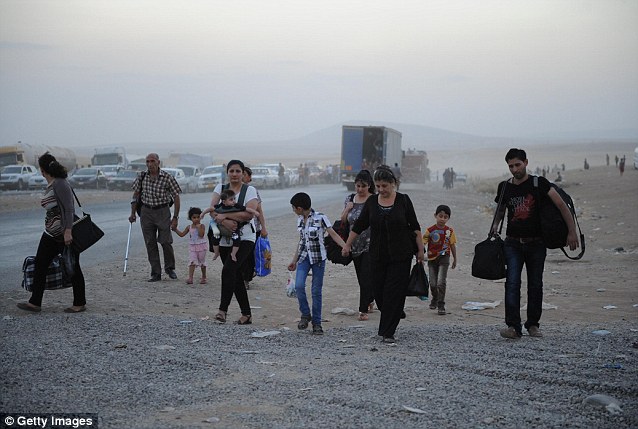
Thousands of Yazidi and Christian people have fled from Mosul to the Kurdish capitol Erbil, also known as Arbil, after the latest wave of advances from Islamic militants that began on Sunday
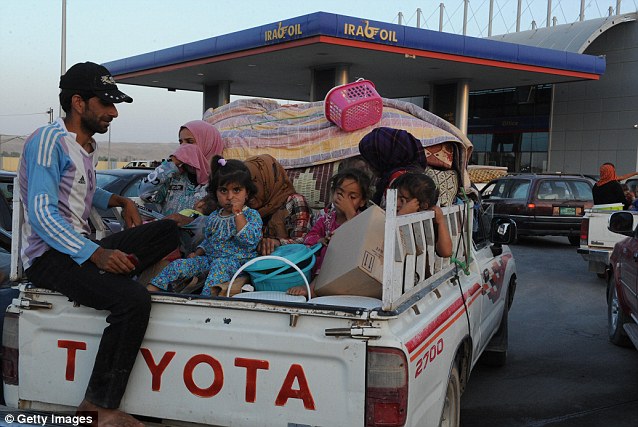
The Islamic State group issued an ultimatum ordering Christians and Yadizis to convert to Islam, pay a religious fine, flee their homes or face death. Many have chosen to leave
The UN says that roughly 200,000 Yazidis have left their homes since the fighting began. Many have taken refuge in the Kurdish capitol of Arbil, also Erbil, in recent days. If Obama were to approve humanitarian assistance to the Yazidis and others, it could be delivered via air drops by the U.S. military. Airstrikes could be used to provide cover allowing the air drops to be made safely. The military could also advise and assist the Iraqi air force on where and how to deliver humanitarian relief supplies. The people familiar with the administration’s thinking insisted on anonymity because they were not authorized to discuss the matter by name. Obama used the threat of an imminent humanitarian crisis as a rationale for limited U.S. military action in Libya in 2010, as forces loyal to Moammar Gadhafi threatened a massacre in Benghazi. The U.S. and NATO partners launched a bombing campaign over Libya, with Obama moving forward without congressional approval. If the president were to approve imminent airstrikes in Iraq, it’s all but certain that he would proceed without formal congressional approval. Lawmakers left town last week for a five-week recess, and there was no sign Thursday that Congress was being called back into town. Some Republicans have expressly called for the president to take action and said he doesn’t need the approval of lawmakers.

Displaced Iraqis have also fled to refugee camps in Turkey’s southern province of Mardin
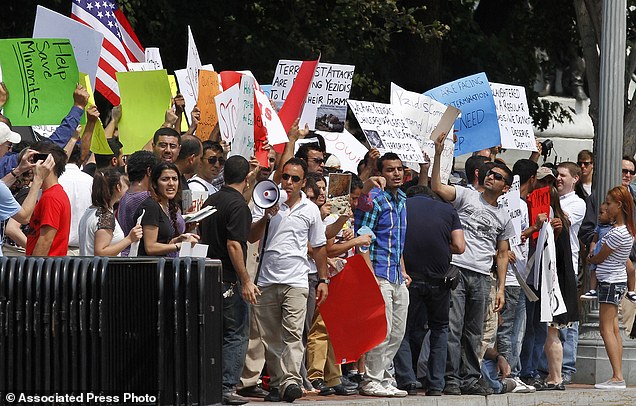
Protesters ask for help for Yazidi people who are stranded by violence in northern Iraq, Thursday, Aug. 7, 2014, across from the White House in Washington. The Obama administration is weighing an urgent response to help trapped religious minorities in Iraq, with one option being delivery of humanitarian aid. (AP Photo/Jacquelyn Martin)
Iraq has been under siege for months by the al-Qaida-breakaway group seeking to create an Islamic state in territory it controls in Iraq and Syria and imposing its harsh interpretation of Islamic law. Iraqi government forces, Kurds and allied Sunni tribal militiamen have been struggling to dislodge the Islamic State militants and its Sunni allies with little apparent success. The Iraqi government has sought military assistance from the U.S., but Obama has resisted. He has cast any military action as contingent on Iraq reforming its political system to be more inclusive, a step the U.S. hopes would lessen the country’s sectarian tension. However, Obama has warned that even if the U.S. were to re-engage militarily in Iraq, it would be in a limited fashion and would not involve putting U.S. combat troops on the ground. His spokesman reiterated those assurances again on Thursday. ‘There are no American military solutions to the problems in Iraq,’ Earnest said. Obama did dispatch more than 800 U.S. forces to Iraq this year following the Islamic State’s gains. More than half are providing security for the embassy and U.S. personnel. American service members also are involved in improving U.S. intelligence, providing security cooperation and conducting assessments of Iraqi capabilities.
The Islamic fighters, who have killed many thousands and declared a caliphate in the area they have conquered, are now threatening the northern Iraq region of Kurdistan, previously considered a bastion of stability in a country ravaged by conflict. The Kurds have made urgent appeals to Washington for arms or other military help, but the United States, committed to helping Baghdad restore a unified state and wary of Kurdish moves toward independence, has so far declined. However, there have been signs the Obama administration may be shifting its position on that front, too. Bernadette Meehan, spokeswoman for Obama’s National Security Council, told Reuters on Wednesday that any provision of US weapons to the Kurds ‘must be coordinated with central government authorities, in Iraq and elsewhere.’ But she added that given the threat from the Islamic State, ‘the United States will continue to engage with Baghdad and Arbil to enhance cooperation on the security front and other issues. ‘We are in continuous consultation with the government of Iraq and the Kurdistan regional government to determine how they can best coordinate’ to confront the militants,’ she said.Meehan said Washington fully supported a decision earlier this week by Baghdad to send air support to Kurdistan.


No comments:
Post a Comment